
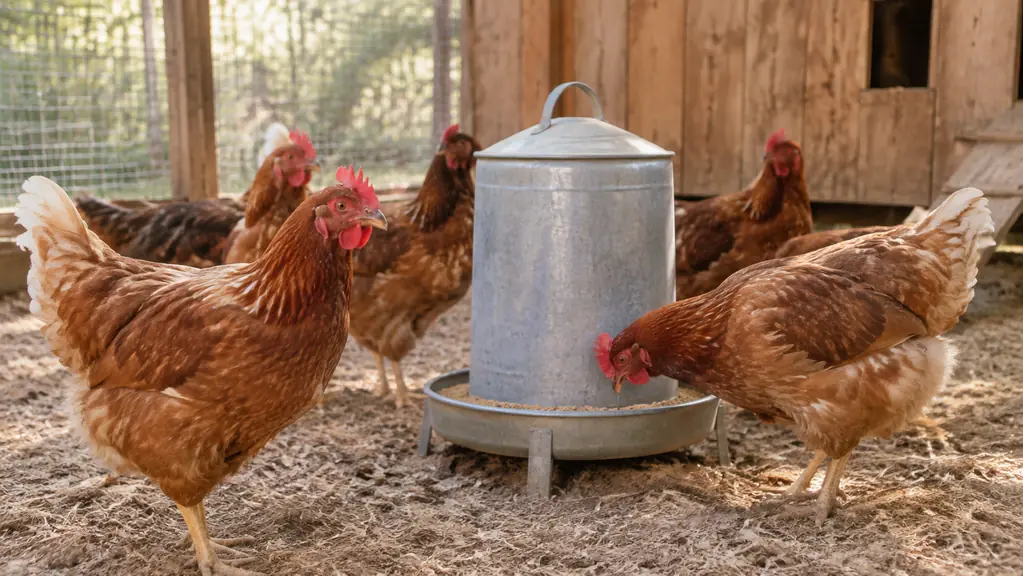
I keep 14 laying hens on four acres outside Siler City, and for a long time I fed them out of an open trough. I told myself the feed on the coop floor was just chickens being chickens. Then I did the math on how often I was buying layer pellets, and I stopped laughing at myself. In May 2024 I set a RentACoop 25lb Chicken Feeder with 4 large ports in the center of the coop floor, on its adjustable stand, and gave it a fair trial. I am not going to tell you it solved every varmint problem. I am going to tell you what changed.
The feeder is not a gadget. It is a covered feeder with four wide ports, sliding covers, a lid, a handle, an anti-roost cone and a stand. RentACoop sells it as a 25lb feeder, and for my 14 hens that works out to about one fill a week with layer pellets. I still keep a scoop in the feed bin and I still look at the floor every morning. Old habits. But the morning sweep is different now, and that is the whole point of this list.
Stop feeding the coop floor
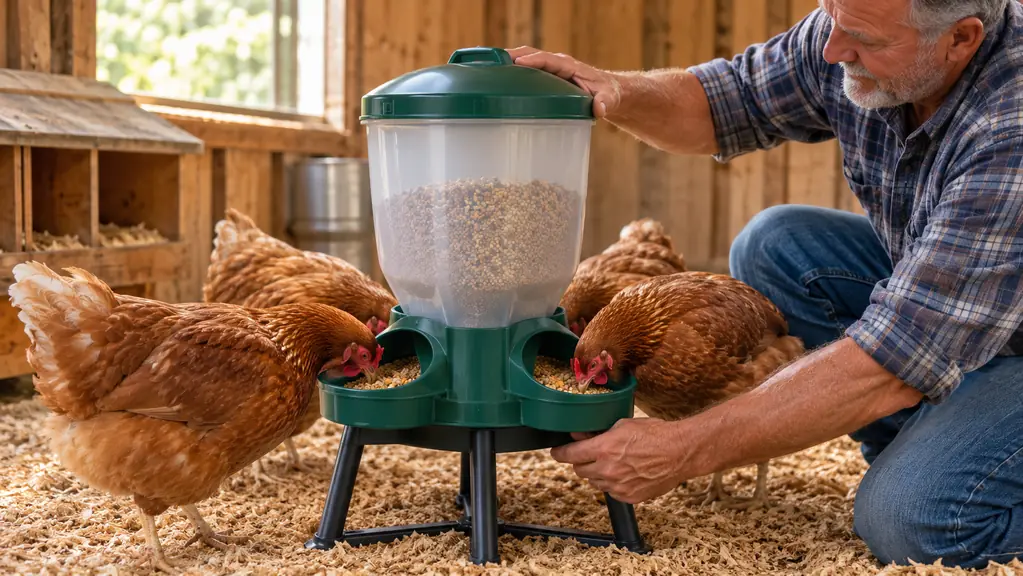
The RentACoop feeder holds a week of layer pellets for a small flock and gives four hens room to eat at once. The sliding covers let you close the ports at night, and the adjustable stand keeps the feeder up out of the bedding.
Amazon Check Today's Price on Amazon →10 Reasons the Feed Stays in the Feeder
The ports are wide enough that hens eat instead of rake
A hen does not need much of an opening to drag a pellet out with her beak. The four ports on the RentACoop feeder are large and open wide, so the hens get their heads in and eat instead of scraping feed onto the floor. I noticed the difference in the first week. The scratch of pellets under the roost got thinner. That sounds small until you are the one sweeping it up every morning.
Four ports spread out the pecking order
With an open trough, the bossy hens stand in the middle and the shy ones wait. Then the shy ones jump in and out and fling feed everywhere. Four separate ports give the flock more places to stand. My Barred Rocks still push, because they are Barred Rocks. But the Easter Eggers can get to a port without running the gauntlet. Less traffic at the feed translates to less feed on the floor.
The lid and handle make a weekly fill less of a wrestling match
I fill the feeder about once a week for 14 hens. The lid comes off, the handle gives me something to grab, and I can pour from a scoop without holding the whole thing between my knees. That is not a dramatic feature. It is the kind of feature you notice when you are 57 and your back is already tired from carrying water. Chores that are easy get done on time.
The sliding covers let you shut the ports without a tarp
I do not claim this feeder is rat-proof. It is not. A determined rat is a determined rat. What the sliding covers do is let me close the four ports at night if I want to, without draping a feed sack over the top like a scarecrow. That is useful in a coop where wild birds and mice are always looking for an easy meal. I close the covers when I think about it, and I sleep better when I do.
The anti-roost cone keeps hens off the top of the feed
Hens like to perch on anything flat. A feeder lid is flat. You can guess what happens next, and you have probably cleaned it up. The anti-roost cone on top of this feeder makes the lid a poor place to stand. That means less manure on the lid and less chance of it getting into the feed when I open it. No moving parts. Just a shape that says no.
The change I noticed was not in the hens. It was in the coop floor: less pellet mash under the roost and more feed going where it belonged.

The adjustable stand gets the feeder out of the bedding
A feeder sitting flat on pine shavings is a rake for chicken feet. The adjustable stand holds the feeder up so the ports sit at a better height and the bedding does not spill into the feed every time a hen scratches. I set mine in the center of the floor on the stand and left it alone. The stand is also the reason I can sweep under the feeder without moving the whole setup every day.
One feed location makes the daily sweep faster
When feed is scattered, you sweep the whole coop. When feed is in one place, you sweep one place. The center placement of this feeder means the mess is concentrated. I keep a small dustpan by the door and hit the spot in under a minute. That does not sound like much until you have done it every morning for a week. Small chores add up.
A 25lb fill lasts my 14 hens about a week
I am not going to pretend I weigh every scoop. I fill the feeder with layer pellets about once a week and it holds enough for my flock. That is the right rhythm for me. I am not out there every morning topping off a trough, and the hens are not waiting on me to get home from town. If your flock is bigger, you will fill more often. The point is that the feeder holds a real amount of feed.
Assembly is quick with the included 13mm bit
The feeder comes with a 13mm magnetic driver bit for an electric screwdriver. I am not handy in a fancy way, but I can run a screw. I put mine together at the kitchen table and carried it out in one piece. The stand stores on the feeder, which keeps the parts together when I move it. That is the whole story. No swearing, no missing bag of bolts.
You can see how much the flock is actually eating
An open trough tells you nothing. Feed disappears, but you do not know if the hens ate it or if it went under their feet. A covered feeder with ports gives you a cleaner read. When I fill it, I know about how long that feed should last. If it starts disappearing faster, I look for a leak, a spill, or a visitor. That information alone is worth the change.
What I'd Skip
If you already have a hanging feeder that works and your floor stays clean, I would not spend money to fix a problem you do not have. I would skip an open trough, and I would skip any feeder you cannot close up at night if you have rats or wild birds. This RentACoop feeder is not a rat-proof feeder. It is a covered feeder with sliding ports, and it works for me because I fill it weekly and check the floor. If you want a set-and-forget varmint solution, this is not that.
Your feed bill is on the floor
If you are tired of sweeping pellets into the shovel every morning, start with the feeder that keeps them in one place. The RentACoop feeder has four wide ports, sliding covers, an anti-roost cone and an adjustable stand. It is not rat-proof, and I will keep saying that. It is a better daily setup for a small flock.
Amazon Check Today's Price on Amazon →