
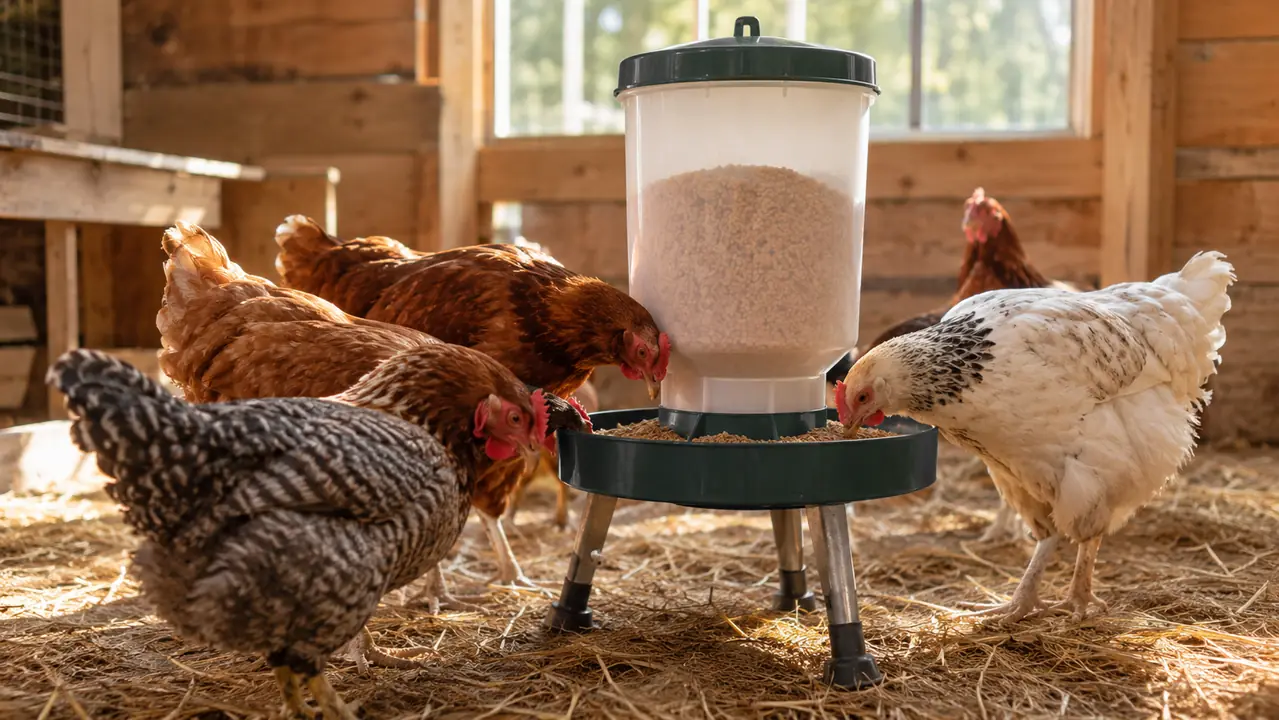
I bought the RentACoop 25lb Chicken Feeder in May 2024 because rats and wild birds had turned my open trough feeder into a cafeteria. I keep 14 laying hens in a walk-in wooden coop with a covered run on four acres outside Siler City, North Carolina. I have also used a plain hanging feeder in that same run. Both will feed a flock. They do not solve the same problem, and that is the whole comparison in one sentence.
A hanging feeder gets feed off the floor and out of the way. The RentACoop feeder puts feed at hen height on an adjustable stand, with four large ports, sliding covers, a lid, a handle, and an anti-roost cone on top. I have used both long enough to know which one I reach for on a muddy morning. Short answer: the RentACoop is the better fit for my coop, but a hanging feeder still wins a few jobs, and I would not pretend otherwise.
| RentACoop 25lb Feeder | Hanging feeder | |
|---|---|---|
| Capacity | 25 lb capacity, 4 large ports | Often 10 to 20 lb, with a narrower trough |
| Mounting | Freestanding on an adjustable stand | Hangs from a hook, chain or rafter |
| Floor space | Uses floor space in the coop | Uses air space and leaves the floor clear |
| Pest access | Sits at floor level, so I use the sliding covers at night | Feed hangs above the floor, out of reach of more rodents |
| Stability | Sits still when a hen lands on the port lip | Can swing when birds jump on and off |
| Cleaning | Lid comes off, wide ports are easy to wipe | Usually has to be unhooked and carried to the hose |
| Feed waste | Wide ports and a lid cut spillage, but hens can still bill feed out | A deeper trough can cut billing, though spilled feed lands below |
| Setup | Assembly needed, 13mm bit included | Hang it and fill it |
| Best for | A flock in the double digits with floor room | A small flock in a tight run with a strong hook |
Where the RentACoop Feeder Wins
The first thing the RentACoop feeder gets right is capacity. It is a 25 lb feeder with four large ports, and that matters when 14 hens decide to eat at the same moment. My old hanging feeder held less and had a narrower trough, so the top hens camped on it and the shy ones waited. With four ports, a Buff Orpington on one side does not block an Easter Egger on the other. The wide openings also make it easier for the hens to get their beaks in without scraping feed onto the floor. I still find some spill, because chickens are chickens, but I fill this feeder about once a week instead of topping off a smaller hanging feeder every few days.
The second win is stability. A hanging feeder swings. That is fine until a heavy hen jumps onto the lip, the feeder rocks, and feed scatters into the bedding. The RentACoop feeder is freestanding on an adjustable stand, so it sits still. I set the height so the ports land near the hens' chests and the stand keeps the body off the litter. The lid and handle make it easy to lift and fill, and the anti-roost cone on top stops the birds from perching and fouling the lid. Assembly took me about ten minutes with the included 13mm magnetic driver bit. The sliding covers are not automatic. I slide them over the ports at night if I want, and I open them in the morning. That is a manual habit, not a machine. Cleaning is straightforward too. The lid comes off, the ports are wide enough to wipe, and I dump the stale feed every couple of weeks.

Where a Hanging Feeder Wins
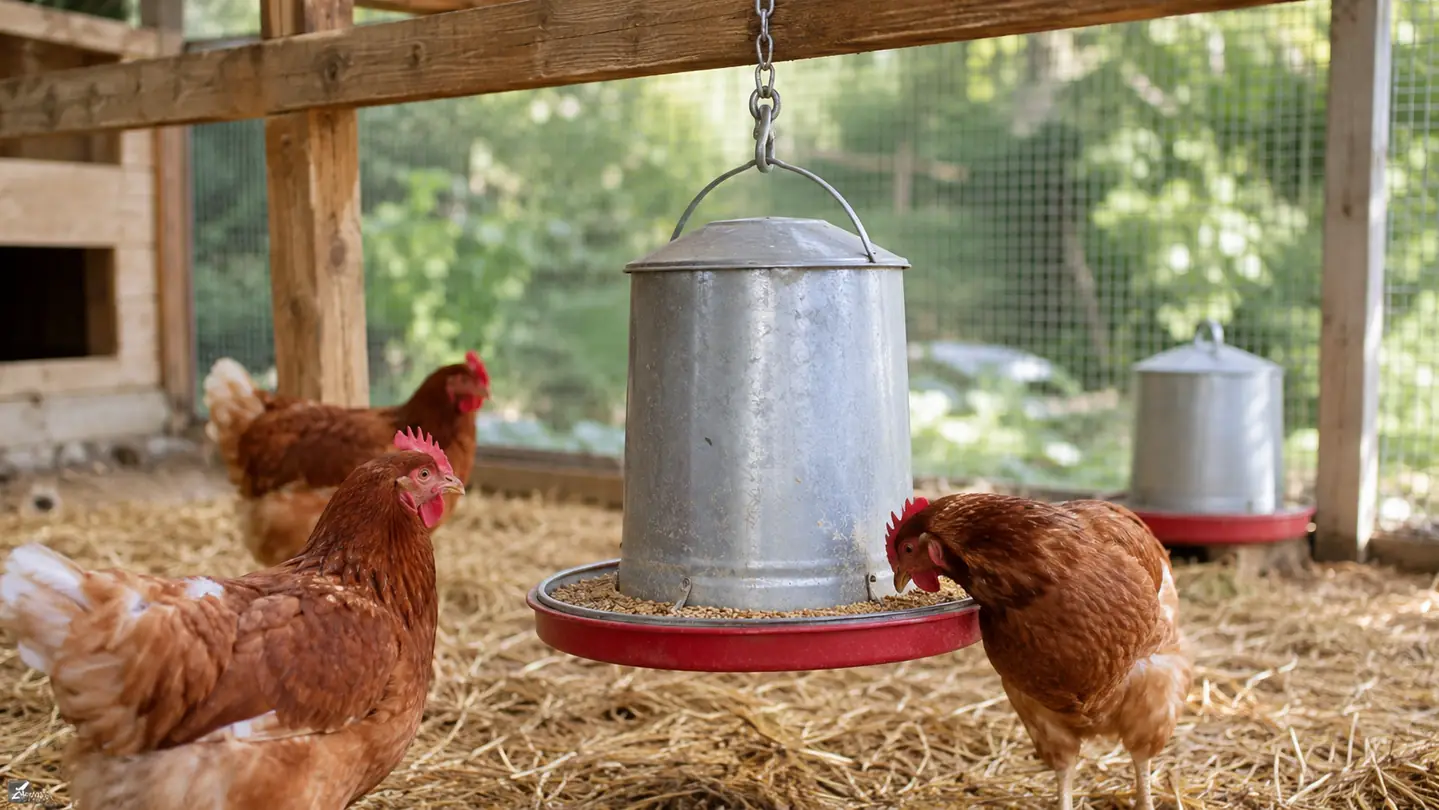
A hanging feeder wins floor space, and it is not close. My coop is not huge, and a freestanding feeder takes up the center of the floor. A hanging feeder uses air space. If you keep a small flock in a tight coop or a run with a good overhead beam, that matters more than capacity. It also keeps feed off the floor, which puts it out of reach of more rodents and keeps it cleaner when the bedding is damp. I still would not call any feeder rat-proof. Rats climb, and a hanging feeder is not a force field. But it starts with an advantage the RentACoop feeder does not have.
A hanging feeder also wins on simplicity. There is no stand, no anti-roost cone, no assembly. You hang it, fill it, and check the chain. For three or four hens, that is often all you need. It is easier to move to a different spot, and if your coop floods or the litter gets wet, you can raise it another link. The tradeoff is swing and smaller capacity. The feeder moves when the birds land on it, and the trough holds less than a 25 lb feeder. If you have a tiny flock and a dry run, those tradeoffs may not bother you at all.
The RentACoop feeder did not make the rats disappear. It made the feed harder to get and easier for me to manage. That is the honest version.
Four ports, one stand, and a lid that covers the feed
The RentACoop 25lb Chicken Feeder is what I use for 14 hens. It holds a week of layer pellets, sits still on its adjustable stand, and the sliding covers give me a way to close it up at night. Check the current measurements and listing before you order.
Amazon Check Today's Price on Amazon →The Daily Chore Difference
On a normal morning I open the coop, slide the port covers back, and check the lid. The RentACoop feeder is in the center of the floor, so I can see the feed level from the door. If the weather has been wet, I check the feeder for clumps. A hanging feeder takes a different check. I look at the chain, make sure the hook has not worked loose, and confirm the feeder is not swinging against a wall. Both checks take under a minute. The difference is what happens when I skip a day. The RentACoop feeder has enough capacity to carry me through, while my old hanging feeder needed a top-off sooner.
Filling is where the RentACoop feeder earns its place. I scoop layer pellets into the feeder, put the lid back on, and I am done. The handle helps because I can lift the whole thing a little to settle the feed. With a hanging feeder, I usually had to hold the feeder steady with one hand and scoop with the other, or take it down and fill it on the ground. That is not hard, but it is awkward with a bucket in the other hand. If you have ever filled a swinging feeder in the rain, you know the difference.
The evening routine is similar, but the RentACoop feeder has one extra step I actually use. I slide the covers over the ports if I am worried about overnight visitors. It is not automatic, and I have forgotten a few times. When I forget, I find signs by morning. That is the honest tradeoff. The feeder reduces the easy meal, but it does not remove the need to store feed in a metal can and clean up spills. No feeder does that job for you.
How I Set Up Each One
I put the RentACoop feeder in the center of the coop floor, not under the roost. That is the one placement rule I would give anyone. The adjustable stand lets me set the ports at about chest height for the hens, and the anti-roost cone goes on top. I keep the lid on unless I am filling it. The 13mm bit that comes in the box is the size I needed for the screws, so I did not have to dig through my toolbox. The built-in stand storage keeps the extra pieces together when I move it for a deep clean.
For a hanging feeder, the hook is the whole installation. I want a hook or beam that will hold the feeder plus a full load of feed without flexing. I hang it so the trough is around chest height for the hens, not at their eye level and not so low that they have to stretch. I keep it away from the roost and away from the wall, because a feeder that rubs a wall will dump feed. I check the chain or cord every few weeks for fraying. That is not a product feature, just barn sense.
Both feeders need dry feed and a clean scoop. I keep pellets in a metal can with a lid, and I do not refill a feeder that has damp feed caked in the corners. If the feed smells off or looks moldy, it goes out. I scrub the RentACoop feeder every few weeks with a brush and a vinegar rinse, then let it dry in the sun before I refill it. A hanging feeder gets the same treatment, just with more unhooking. The feeder is only half the job. The other half is the feed you put in it.
What I'd Tell a Neighbor
If you have rats, do not buy a feeder and expect the problem to go away. I bought the RentACoop feeder because rats and wild birds were in an open trough, and it helped. It did not end the war. I still keep feed in a metal can, I still clean up spills, and I still slide the covers at night. If a neighbor asked me which feeder to buy, I would ask two questions first. How many hens do you have, and how much floor space can you give up? Fourteen hens and a coop with room in the middle points to the RentACoop. Four hens and a tight run with a good beam points to a hanging feeder.
Measure before you order, whichever way you go. The RentACoop feeder is 14.29 by 12.01 by 10.94 inches and weighs 2.8 pounds empty. That is small enough for my coop, but it is still a footprint on the floor. A hanging feeder needs overhead clearance and a hook that can carry the weight of a full feeder. I have made the mistake of hanging a feeder from a hook that was meant for a plant. It held until the first heavy rain, then it sagged. Fix the hook before you fix the feeder.
Who Should Buy Which
Buy the RentACoop 25lb feeder if you keep a flock in the double digits, if your hens crowd the feeder at morning and dusk, or if you are tired of a swinging feeder that dumps feed when a heavy bird lands on it. It is also the better choice if you want a lid, a handle, and a stand that sets the height without chain adjustments. The four large ports and the 25 lb capacity are the reasons I use it for 14 hens. It is not the right pick for a coop where every square foot of floor is already spoken for.
Buy a hanging feeder if you have a small flock, a dry run, and a strong overhead hook. It keeps the floor clear, it is simple to install, and it is easy to move. It is also a reasonable backup feeder if you want to keep a second feed station in the run. Do not buy either one if you are not going to keep the feed dry and clean the feeder. A dirty feeder is worse than a clean trough, no matter what shape it is.
The feeder I would buy again for a flock this size
For 14 hens in a wooden coop, the RentACoop 25lb feeder is the one that stayed. Four ports, sliding covers, an adjustable stand, and a lid. If your coop has the floor space, start there.
Amazon Check Today's Price on Amazon →