
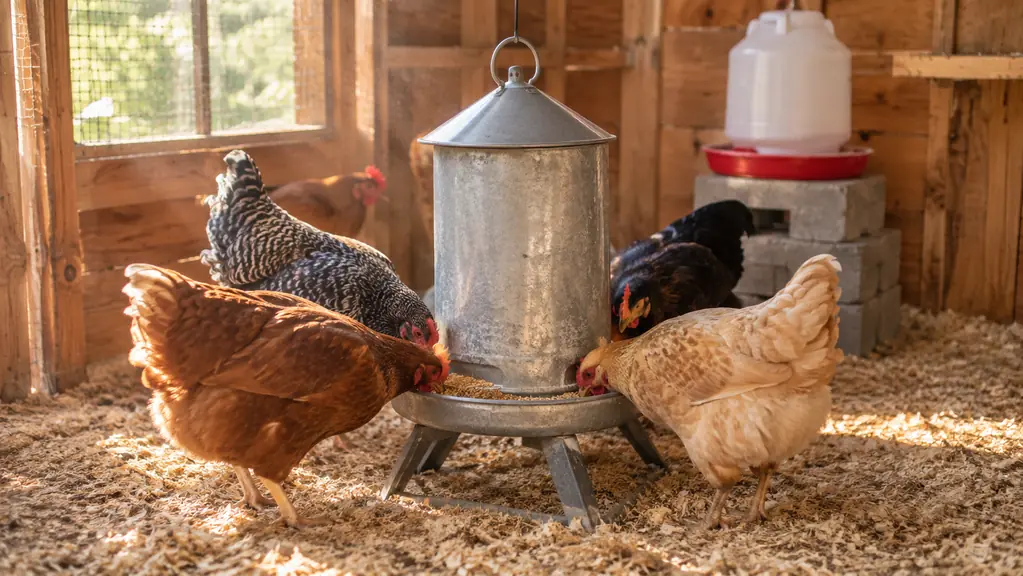
Two summers back I filled the trough feeder in the coop on a Sunday morning, and by Thursday afternoon the hens were scratching at bare metal. I blamed the hens for a week. Then I found the droppings along the back wall and the small tunnel dug out under the run skirt, and I stopped blaming the hens. Rats and wild birds were eating better than my flock was, and I was the one carrying the feed out there to make it happen.
So in May 2024 I bought the RentACoop 25 lb Chicken Feeder with four large ports, set it on its stand in the middle of the coop floor, and dropped the anti-roost cone on top. I have filled it once a week ever since for fourteen hens. Two summers, one January that froze the drinker solid, and a wet spring later, I have a fair amount to say about it. Most of it is good. A little of it is me admitting I set it up wrong the first week.
The Quick Verdict
A freestanding four-port feeder that cut the feed on my coop floor by a wide margin. Buy it for the port design and the stand, not because you think it will run off the rats.
Amazon Check Today's Price →Feed that stays in the feeder instead of on the coop floor
Fourteen hens, one fill a week, and a lot less scooping feed out of the litter. Four large ports with sliding covers, an adjustable stand and the anti-roost cone all come in the box.
Amazon Check Today's Price on Amazon →How I've Used It
My setup is a walk-in wooden coop with a covered run, fourteen laying hens, a mix of Buff Orpingtons, Barred Rocks and Easter Eggers, and no rooster. Before this feeder I used a galvanized trough that sat flat on the floor. It worked, in the sense that feed came out of it. It also worked for every rat within a quarter mile of Siler City.
The RentACoop feeder goes together with an electric screwdriver. There is a 13mm magnetic driver bit in the box, which sounds like a small thing until you are standing in a coop holding a loose port in one hand with no idea where your bits went. The stand has storage built in for that bit, so it stays with the feeder instead of migrating out to the truck and never coming back. I put mine together on the porch in about twenty minutes and carried it out one-handed.
It stands freestanding on the coop floor, dead center, which is the placement RentACoop calls for. The footprint is about 14 by 12 inches and the whole thing weighs under three pounds empty, so I lift it out to the run when I scrub the floor and set it back. Filling is a weekly job. Pop the lid, dump in a scoop of layer pellets, close it up, done in under two minutes.
Fourteen hens on one fill a week is the short version of my last year. The longer version is that I used to make a second feed store run most weeks, and I have not done that since June of last year. Not once.
What the Four Ports Actually Change
The old trough was open along its entire length. A hen could step into it, scratch through the pellets and throw half of them over her shoulder. Feed on the floor means feed in the litter, and feed in the litter means rats and wild birds and a flock eating off ground where the droppings land.
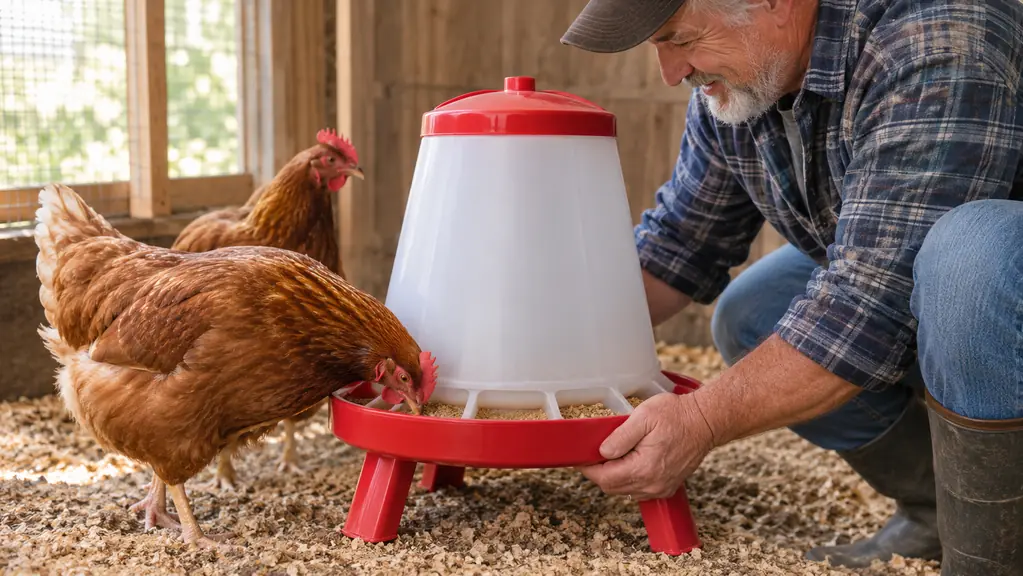
Four ports with wide openings do something different. A hen puts her head in, she eats, she pulls her head out. She cannot stand in the feed and rake it around. That is the whole design idea, and it holds up. Within a week the floor around the feeder was cleaner. By the end of the first month, the feed I was scooping out of the litter had dropped a lot, and the pellets were going into hens instead of into the bedding.
Each port has a sliding cover. I want to be plain about that, because I have heard people assume the covers work on their own. They do not. They are covers, and you slide them. I close mine at dusk in wet weather and leave them open most of the time, because closing them at night means opening them in the morning, and I know exactly how many mornings I would walk right past them. If you want the ports shut overnight, you will be the one shutting them.
What I tried first, for the record, was a length of PVC pipe with an elbow on the end, the sort of thing that gets passed around on the forums. It worked for about six weeks. Then the hens figured out they could hook a beak into the open end and drag pellets onto the floor a few at a time, and the whole point was gone. Before that I hung a feeder from the rafter, and it swung every time a hen bumped it, which scattered feed and made a racket at five in the morning. A four-port feeder sitting still on a stand did what neither of those did.
The openings are big enough that a full-grown hen gets her head in comfortably, and the count of ports matters more than the size of any one of them. Four birds eat at once instead of one bird standing guard over a single opening and pecking the others away. In a flock of fourteen that has made a difference at feeding time. There is less shoving and less squawking than there used to be.
The Stand, the Anti-Roost Cone, and the Small Bit
The feeder comes with an adjustable stand, and the stand is the piece I would not want to do without. Mine has been at two heights. The first week I had it low, thinking the hens would rather eat down near the litter, and I stood there watching a Buff Orpington crane her neck sideways to reach a port. I raised it a notch and the difference was immediate. Heads went in level, birds stayed at the port longer, and the shoving settled down. It now sits so the ports land at about chest height on the hens, which means nobody is stretching up or hunching down to eat.
The stand also holds the whole feeder off the litter. The litter underneath stays drier than the litter around the old trough ever did, and that matters more than it sounds like it does in a wet spell.
The anti-roost cone goes on top, and it is exactly what it sounds like. Hens will land on top of a feeder, settle in, and leave everything they came with in the feed below. The cone makes the top a spot they cannot comfortably get set on. I put mine on the first day and have never taken it off. Anyone who skips it will find out inside a month why it was in the box.
The 13mm magnetic driver bit tells you somebody at that company has assembled one of these in a cold barn. It is not a feature anyone brags about. It is a feature that saves you a walk back to the shop. Same with the bit storage in the stand. Small things, but real ones, and they are the kind of detail that separates gear built by people who use it from gear built by people who do not.
Fourteen hens, one fill a week, and by the end of the first month I was scooping noticeably less feed out of the litter.
What It Has Not Fixed
The feeder is not rat-proof, and RentACoop does not claim it is. What it does is take away the easy meal. I spent the first month of that summer doing the unglamorous part: snap traps along the back wall set in the evening and checked every morning, a bucket trap, and a rake dragged through the litter to pull out the spilled pellets that were feeding them. That is what thinned the rats out. The feeder is what kept them from coming back to a set table.
The rats living under my coop did not vanish. They got thinner, and they got bolder around the goat shed, which is a separate problem I handled on its own. If you buy this expecting the rats to pack up and leave, you will be disappointed, and that is not the feeder's fault.
It does not keep out a determined wild bird while the ports are open, though the birds around my place gave up quickly once they could not stand in the feed and thrash around in it. And it does not clean itself. Twice a month I dump what is left, wipe the inside down and let it dry in the sun. Pellets that sit in a humid coop will clump, and clumped pellets will bridge up and stop feeding down the ports. Five minutes with a dry rag prevents all of that.
One more thing, and it cuts both ways. It is light. That is a plus when you carry it out to scrub the floor and a small minus if something bumps it. My Biscuit is an eight year old farm dog who could not care less about the inside of a coop, so there is no trouble here, but the feeder sits freestanding and a solid nudge will move it. It has never tipped over on me. It has shifted.

A Year In: What Held Up and What Didn't
The body has held up. No cracks, no rust coming through, no port worked loose and started dribbling pellets onto the floor. The lid still seats flat. The sliding covers still slide. The stand still sits level on a floor that is not level, which says more about the stand than it does about my coop.
The plastic has faded some from two summers of light through the coop window. That is cosmetic and I do not care about it. What I do keep an eye on is the inside of the hopper where the pellets rub as they feed down. It is scuffed, not worn through. My honest expectation is that this feeder outlasts the trough it replaced, and that trough was galvanized steel.
Spring was the test I did not plan for. We had a stretch in April where it rained most of a week, and the coop floor picked up a dampness it usually does not carry. That was the one time the pellets in the hopper started to bridge up, and I found it because the hens were fussing at empty ports with feed still sitting above them. I emptied the hopper into a bucket, wiped the inside dry, let it sit out in the sun for an afternoon, and poured the feed back. No loss beyond the afternoon. Since then I empty and wipe it every other week whether it looks like it needs it or not.
If there is one thing I would change, it is the fill interval. Weekly works for fourteen hens. At twenty five birds I would be out there twice a week, and popping that lid twice a week in January is not my favorite chore on this place. That is not a flaw in the build, it is arithmetic, but it is worth knowing before you order.
What I Liked
- Four large ports with wide openings, so hens cannot stand in the feed and rake it onto the floor
- Adjustable stand puts the ports at a comfortable height and holds the feeder off the litter
- Anti-roost cone included, which stops hens fouling the feed from above
- Sliding port covers for wet weather or overnight, if you are the sort to remember them
- Assembles in about twenty minutes with the included 13mm magnetic driver bit
- Freestanding and light enough to lift out for a floor scrub
Where It Falls Short
- The covers are manual. Nothing closes on its own.
- Not rat-proof. It removes the easy meal, not the rats.
- Pellets clump in humid weather if you never empty and wipe it out
- Light enough to shift if something bumps it
- One fill a week at fourteen hens, so a bigger flock means more trips
Who This Is For
This is for the keeper with a flock somewhere between a handful and about twenty birds, a coop with floor space to set something on, and a feed bill that keeps creeping up for reasons that are hard to pin down. If you are finding pellets in the litter and droppings you did not put there, this is the first thing I would change. Cleaner litter, one fill a week and pellets going into hens is a fair summary of my last year with it.
It also suits anyone who has been hauling feed out to the coop two or three times a week. The savings in time are not dramatic on any single day. Over one winter, they add up to something you notice.
Who Should Skip It
Skip it if you have a real rodent problem and you want the feeder to solve it. It will not. Handle the rats first, with traps and a barn cat and by cleaning up the spill around the coop, or you will end up blaming a metal and plastic box for a job that was never its job.
Skip it if your coop has no floor space to set it on, or if everything in your setup hangs from the walls. It is freestanding and it wants to stand on a floor. That hanging versus standing decision is a real one, and it is worth thinking through before you commit. And skip it if you want ports that open and close without you, because these do not do that and never will.
One fill a week for fourteen hens is the part I would pay for again
Four large ports, an adjustable stand, an anti-roost cone and sliding covers. It will not run off the rats. It will keep the feed where you put it, and keep the litter cleaner while it does.
Amazon Check Today's Price on Amazon →