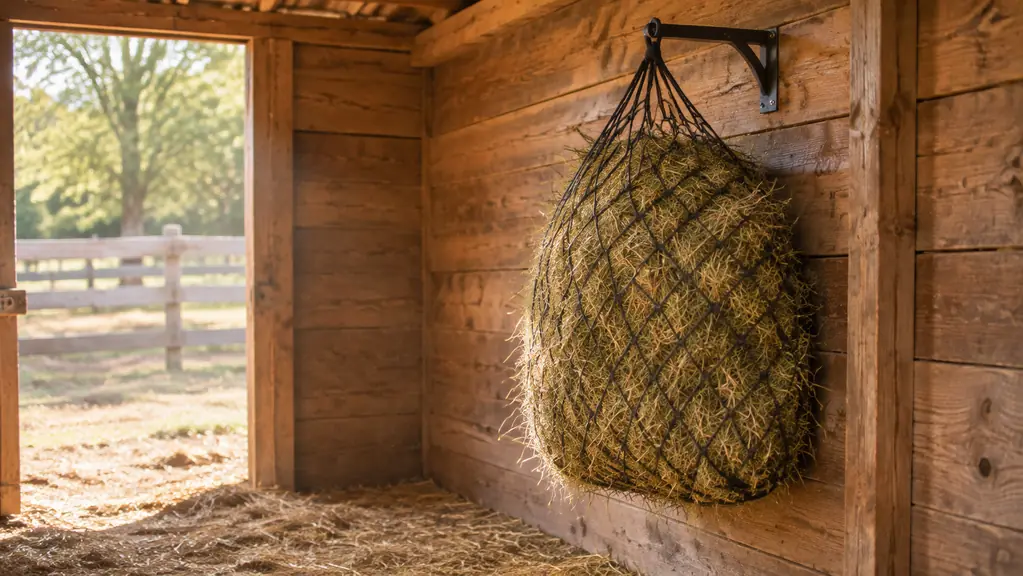
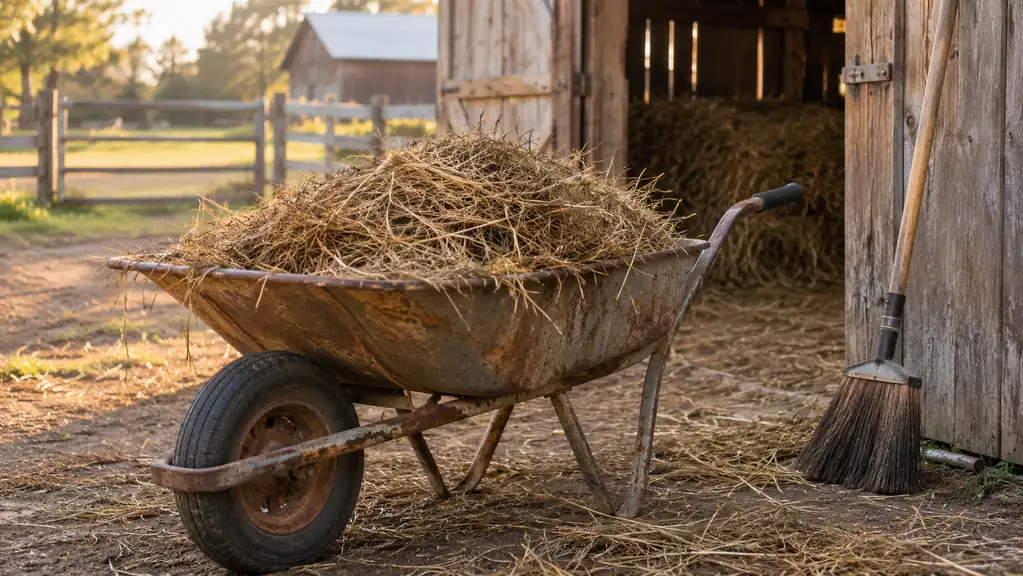
Hay is the one grocery bill on this place that never goes down. For a long time I told myself the goats were eating what I put out, and then one February I swept the shed floor and filled most of a wheelbarrow with hay the does had pulled out, sniffed at, and stepped on. That was the end of the open rack for me. I bought a Tough 1 Slow Feed Hay Net in November 2024, hung it on an eye bolt in the goat shed, and the wheelbarrow has been a lot lighter since.
I am not going to pretend a net fixed everything. It did not. But it changed the way hay gets eaten in my shed, and it did it for a lot less fuss than building a rack. Here are ten plain reasons it cut my waste, in the order I noticed them.
What my does eat off the wall instead of off the floor
The Tough 1 Slow Feed Hay Net is a large polyester net with 2 inch knotted openings. It hangs on one eye bolt and comes down in a second when you need to fill it.
Amazon Check Today's Price on Amazon →Ten Reasons, In The Order I Noticed Them
The pull and trample cycle stops cold
An open rack lets a goat take a big mouthful, decide she wants a different mouthful, and drop the first one on the floor. Then she steps on it. Multiply that by three does and a five month winter and you are buying hay to line the floor of your shed. With the net, every mouthful takes some work to get, so it tends to get eaten instead of dropped. The first week I noticed the floor stayed cleaner. By the second week I noticed the bale in the barn was lasting longer, and that is the number that actually matters.
The 2 inch knotted openings set the pace for them
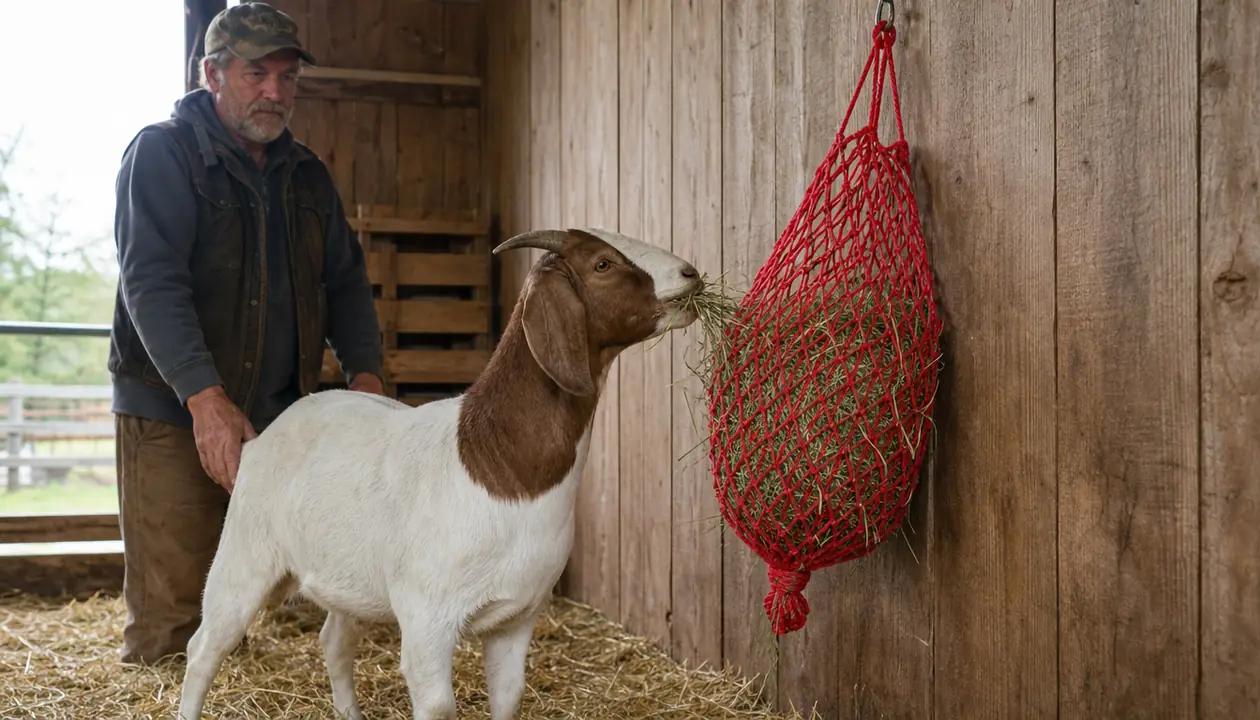
The listing calls them 2 inch knotted slow feed openings, and that size is the whole point. A goat can get a good pull through them, but not a faceful. It turns eating into something closer to grazing, a little at a time, the way they eat brush out in the paddock. Slow is not a punishment here. It is the reason less hay ends up on the ground, and it gives a bored doe something to do besides stand at a rack and fling hay for entertainment. The Tough 1 net lists those openings at 2 inches and that is what I would look for if I bought another.
Less hay in the bedding means less to fork out
Wasted hay costs you twice. Once when you buy it, and again when you fork it out of the bedding with the manure. Hay that lands on straw gets walked in, breaks up, and turns a ten minute job into a twenty minute one. When the hay stays in the net, the straw stays straw. I use less bedding than I did with the rack and the Saturday muck out goes faster. That is a small thing that repeats every single week of the year.
One fill gets three does through a winter day
I fill it once a day in winter. The net is a large size and it holds plenty of hay, which for my three Nigerian Dwarf does is more than they clean up in a day. In summer, when they are out on the browse paddock most of the day, one fill stretches a good deal further than that. Either way it is one trip to the bale in the morning instead of three or four trips with an armload, and that matters when it is 28 degrees and the water buckets have a skin of ice on them.
It hangs on one eye bolt and gives the floor back
A rack sits on the floor and eats floor space. The net hangs on a single sturdy eye bolt on the shed wall, so the floor under it stays open and sweepable. In a converted three stall shed where I am already stepping around water buckets, a milk stand and a mineral feeder, that is worth something. I put the bolt at about the height of the goats' heads and pulled the bottom of the net up and tied it off, so nothing dangles down where a leg can find it.
Polyester mesh does not turn into a wet hay brick
The net is polyester, and that shows up in a wet winter. Hay packed into a damp corner of a rack can go musty before anybody eats it. Hay in a net has air moving around it and I have not pulled out a wad that had gone off. I do not leave hay in it in the rain and I check it at every fill, but the net itself is dry again by the next morning instead of holding water the way heavy canvas does. Small thing. It adds up over four months of wet weather.
It goes in the trailer without building anything
The listing says it is great for shows or the trailer, and that fits what it is. When I take a doe to the neighbor's for breeding, I fill the net, tie it to a ring in the trailer, and she has hay in front of her the whole ride instead of a loose flake sliding around the floor. Nothing to bolt down. Nothing to unbolt when we get home. It comes off the ring, goes in the tack box, and hangs back up in the shed that evening.
Three does can eat at once without a shoving match
One rack and three goats means somebody gets pushed off the feed. A net gives them more surface to spread around. Hazel and Pepper work opposite sides of it and Clover takes the bottom corner, and nobody is getting shoved away from a single feed point. Mine are disbudded, so horns are not the worry they would be in a horned herd, but the crowding is the same either way, and the net spreads it out.
You can hang it high enough to keep legs out of it
This is the part I would tell anybody standing in my shed. A net on the floor is a hazard. Hung right, with the bottom pulled up and tied off above leg reach, it is not. I put mine at head height and tied the slack up so no loop hangs loose. If you keep horned goats, hang it higher still and watch them for a week before you trust it. A goat with a horn or a leg through a net is a vet call and a bad afternoon, and it is entirely avoidable.
It went up in November 2024 and it is still the net I fill
There is nothing on it to break. No moving parts, no hardware to lose, nothing to adjust. I check the knots when I fill it and I have not had one let go. When it gets grubby I rinse it and hang it in the sun to dry. It went up in November 2024 and it is still the net I fill every morning. For a piece of gear that takes a beating twice a day, that is the whole review from me.
None of this is complicated. A net is not a machine and it will not fix a hay supplier problem or a goat with a bad tooth. What it does is put the hay where the goat has to work for it and keep it off the floor, and that alone changed how much I get out of a bale.
What I'd Skip
If you have one goat in a small pen, you may not need this. A single doe eating out of a rack in a small pen is not wasting enough hay to matter, and a net is one more thing to fill and tie twice a day. I would also skip hanging one if your shed has nothing solid to bolt into, because a net tied to a wire panel will sag and drag and then you have a floor net, which is the thing you were trying to avoid in the first place. And if a goat in your herd has a history of getting herself caught in things, fix the hanging height first and watch her for a week before you walk away.
One more thing. If your goats are wasting hay because the hay itself is stemmy and they are sorting through it, a net will slow the sorting but it will not make bad hay good. Buy better hay first, then hang the net. And I am not a veterinarian. If a goat goes off feed for any reason at all, that is a call to yours, not a feed net question.
I filled most of a wheelbarrow with hay the does had pulled out and stepped on. That was the end of the open rack.
One eye bolt, one fill a day, less hay on the floor
The Tough 1 Slow Feed Hay Net is a large polyester net with 2 inch knotted openings. Hang it at head height, tie the bottom up out of reach, and see what your shed floor looks like in a week.
Amazon Check Today's Price on Amazon →