
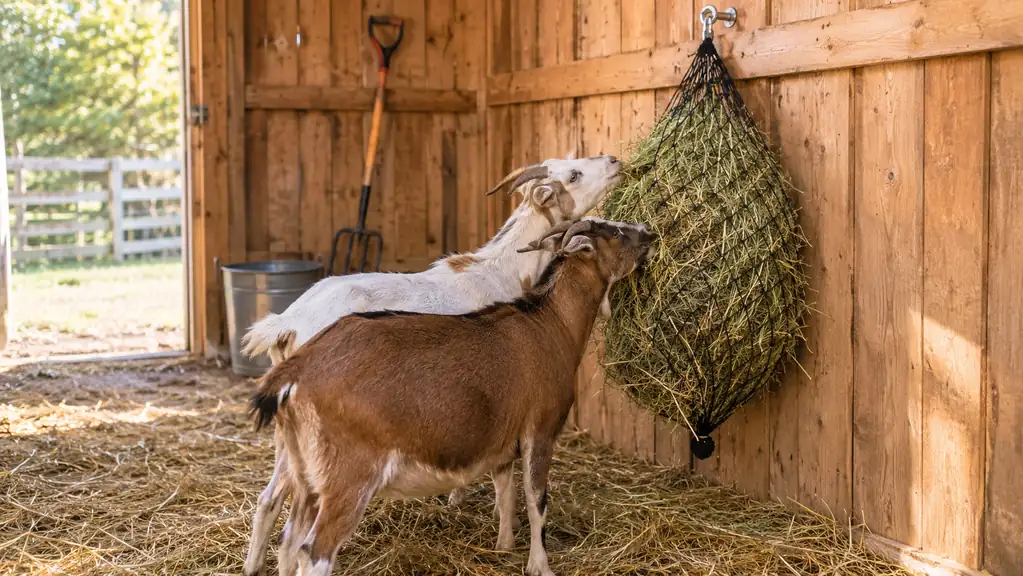
Hay waste sneaks up on you. In July you do not notice it. In February you are standing in the goat shed with a pitchfork, scraping a matted layer of trampled hay off the floor, and it occurs to you that you paid for every ounce of it. My three Nigerian Dwarf does were doing exactly that to an open wall rack. They would pull a mouthful, drop half of it, step on it, and go back for more. In November 2024 I took the rack down and hung a Tough 1 Slow Feed Hay Net on the shed wall in its place. It has been filled almost every day since.
I bought the net myself and nobody sent me one to try. I am writing this because when I went looking for a plain account of how a hay net holds up in a small goat shed, most of what I found was written for horse people with trailers and show schedules. There is nothing wrong with that, but it is not my barn. This is what roughly ten months of daily filling has looked like on four acres outside Siler City, with three does, fourteen hens and a farm dog who is not allowed anywhere near the hay.
The Quick Verdict
Roughly half the hay that used to end up on my shed floor now ends up in a goat. The net itself is a simple polyester bag with a 90 day guarantee, so plan on replacing it eventually, not never.
Amazon Check Today's Price →The bag that halved my shed-floor hay waste
Same net, hung the way I describe below. The current price and the sizing details are on the listing, and the guarantee runs 90 days from purchase.
Amazon Check Today's Price on Amazon →How I've Used It
The setup is simple enough to describe in one sentence: a sturdy eye bolt screwed into a stud in the shed wall at about the height of the goats' heads, the net hung from it, and the bottom pulled up and tied off short. That last part matters more than anything else in this review, and I will come back to it. I fill the net once a day in winter, usually in the morning after I let the does out of the stall and before I haul water. In summer, when they are on browse in the paddock most of the day, I fill it every other day and they mostly ignore it.
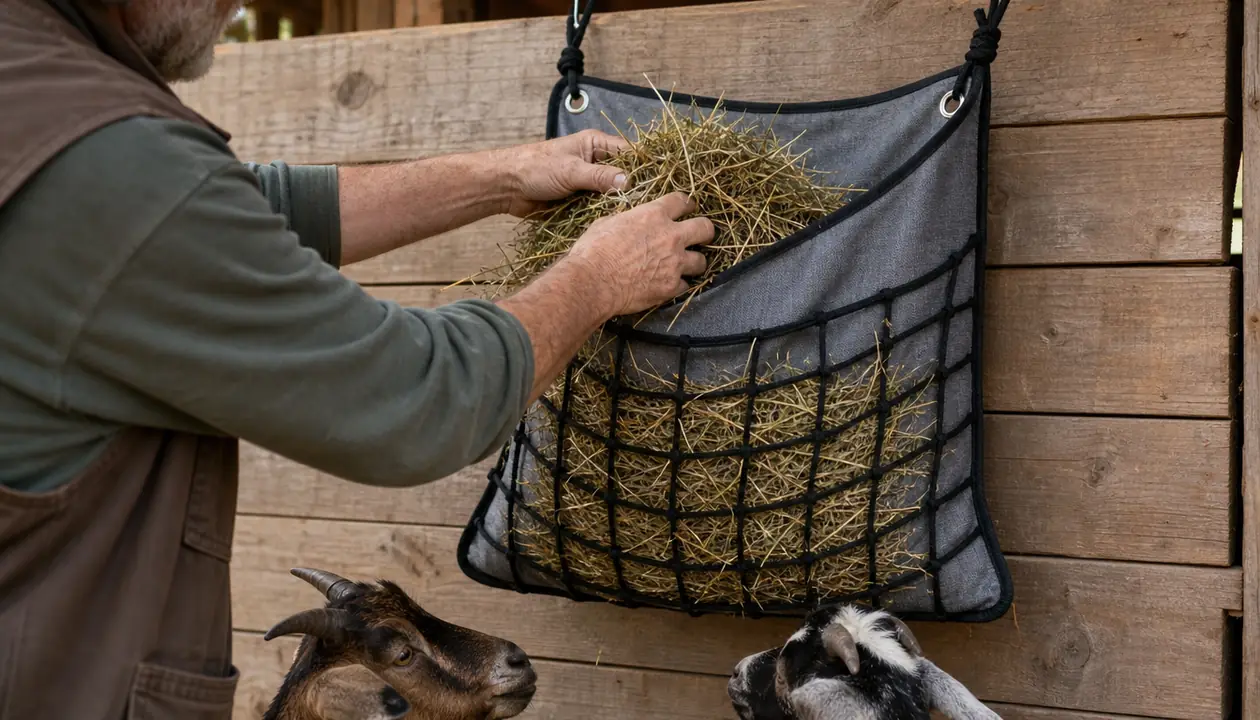
Mine gets second-cutting mixed grass hay, the same hay I put in the manger. The first week I did it wrong. I jammed a whole flake in at the top in one piece and it packed itself into a tight plug that the does quit on by early afternoon, and then they stood at the gate and griped at me about it. Now I break the flake apart and push it in by the handful, working from the bottom up so it does not wad at the top. A full net lasts my three does most of a day. Hazel and Pepper are in milk, so they eat more than Clover, and Clover has learned to wait them out and clean up what the other two leave behind. Filling it takes me about four minutes with cold hands and about two with warm ones, which is a strange thing to know about yourself but there it is.
Cleaning is a shake and a hose. Once a week or so I take the net down, turn it inside out, shake the fines into the compost, and rinse it. Hay dust collects in the knots and holds moisture if you let it sit. In the cold months I bring it into the mudroom overnight when the forecast is for freezing rain, because a wet net that freezes stiff is miserable to fill and the goats will not work at it. Ten months in, that routine has not changed.
What It Is, Per the Listing and My Own Hands
The Tough 1 net is a polyester bag with two inch knotted openings. The listing gives the size as 12 by 4 by 3 inches and just over nine ounces, which is the net folded and bagged, not the net hanging full. The description says the large size fits plenty of hay, and that matches what I see: I can get most of a flake in comfortably. It also lists the target species as horse and the recommended uses as camping, hiking, car and outdoor, which tells you exactly who it was designed for.
That is worth saying plainly, because I am not the customer this net was built for. It is a trailer-and-show piece. I am using it in a converted three-stall shed for dairy goats, which is a different job with different failure points. What carries over is the two inch opening, which is small enough that a goat has to nibble rather than pull a mouthful, and the knotted polyester, which has enough give to it that I am not worried about lips and gums the way I would be about wire.
The guarantee runs 90 days from purchase through JT International. I want to be honest about what that means. It covers you against a net that comes apart in the first three months. It does not cover a net that wears thin after two years of daily hay, and it does not cover weather. Treat the 90 days as a defect window, not a lifespan.
How I Hung It, and Why the Height Is the Whole Thing
A hay net on a wall is a snare if you hang it wrong. I put the eye bolt in a stud at roughly the height of the does' heads, so the top of the net sits about level with their shoulders when they stretch up. Then I gathered the bottom of the net and tied it off short, so a full net hangs like a sack with its lowest point well off the floor, about chest height on a goat. No goat can put a foot in it, and no goat can get her head caught under a loose fold.
The first bolt I put in went too low, about knee height on me, because I was thinking about how easy it would be for me to reach. That was a mistake and I knew it the first evening, when Clover put a front foot up on the bottom of the sack and leaned on it. I moved the bolt up in the second week, patched the old hole with a dowel and wood glue, and the net has hung higher ever since. Measure against the goats, not against yourself.
My does are disbudded, so I do not have horns to worry about catching in the mesh. If you have horned goats, I would not hang a net at all. That is not a knock on the product, it is a fact about horns and openings. I check the knot at the bottom every single time I fill it, the same way I check the gate latch, because a knot that works loose drops the net to the floor and then you have a goat standing in her own hay.
I also added a second tie near the top so the net cannot swing. A net that swings invites head-butting, and head-butting wears mesh. Since I tied it off against the wall, the does eat from it calmly instead of making a game of it, and the mesh at the top looks nearly new.
What Changed in the Shed
The waste number is the one people ask about, so here it is: wasted hay dropped by roughly half. Before, I was forking a full wheelbarrow of trampled hay and soiled bedding out of the shed every two weeks or so and dumping it on the compost. Now it is closer to half a barrow, and the floor under the net stays cleaner between cleanouts. I did not weigh anything. This is one woman with a pitchfork and a compost pile, not a study.
February is the month I actually counted, because I was curious and because the compost pile had gotten away from me. Eleven wheelbarrow loads out of that shed in February 2024, and six in February 2025, same three does, same hay, same woman with the same pitchfork. I am not going to pretend that is a controlled trial. It is two Februaries and a notebook, and I would still bet the difference on the net.
The other change is pace. Goats eating from an open rack eat fast and then stand around looking for something to do. Off the net, a mouthful takes longer to get, so the same hay stretches further across the day and there is less shoving at the manger. My does sorted out the pecking order in the first week, and now Hazel takes one side and Pepper the other and Clover waits her turn. Nobody has gone off feed and nobody has lost condition. I judge that by eye and by the milk pail, and the pail has not changed.
What the net has not done is let me feed less hay. A slow feeder stretches the same amount of hay over more hours. It does not replace any of it. My does still get the same total every day, and if you are hoping a net will cut your hay bill by a third through some kind of trick, it will not. It cuts the hay that goes on the compost, which is a different line on the ledger entirely.
One more thing and then I will stop preaching. A slow feeder is not a substitute for forage, and it is not a substitute for a vet. My goats are out on browse most of the day and the net is what they come back to. If a goat is dropping weight, coughing, or off her feed, that is a call to the vet, not a hay net problem. I am not a veterinarian and I do not play one in the shed.
Where It Shows Wear
Ten months in, the Tough 1 net is still whole, but it is not new. The knots at the bottom, where it rubs the eye bolt and the wall, have gone fuzzy. The polyester has stretched a little, so a full net now hangs slightly longer than it did in December. The mesh at the very bottom, where the does work hardest, is thinner than the mesh at the top. None of that has caused a failure yet. I expect it will eventually, and I would rather say so now than pretend otherwise.
At the four month mark I held it up to the shed window and it looked close to new except for the bottom third. The gap between month four and month ten lives almost entirely in that bottom third, where the does do their work with their lips and their feet. If you are the kind of person who wants to buy one net and be done, buy two and put the second on a shelf in the tack room, because the day is coming when you will want it and it will not be a day you feel like shopping.
The single biggest annoyance is that one net is one feeding. If I am going to be gone overnight, I either hang a second net or talk Ron into filling this one at midday. A rack holds more. That is the trade: a rack wastes hay, a net costs you time. For a shed with three goats, the trade is worth it. For a barn with twelve head, I would be looking at something bigger and I would not bother with a bag at all.
Freezing weather is the other one. Wet hay in a net freezes into a block, and a goat will stand there and lick at it rather than work. On those mornings I break the block up with my hands before I hang it, which adds five minutes I do not have. The 90 day guarantee does not cover weather and it does not cover wear. It covers the net coming apart, which mine has not done.
What I Liked
- Two inch knotted openings slow eating down without making the goats work so hard they quit
- Cut trampled hay in my shed by roughly half over ten months
- Polyester mesh has enough give that I am not worried about lips and gums the way I would be with wire
- Light enough to carry in one hand and shake out over the compost
- Hangs from a single eye bolt, so it fits a shed wall where a rack would not
Where It Falls Short
- One net is roughly one feeding for three goats
- Knots fuzz and the mesh thins with daily use, so plan on replacing it
- The 90 day guarantee is a defect window, not a lifespan
- Wet hay freezes into a block in cold weather
- The listing is written for horses and trailers, so goat keepers have to work out hanging height themselves
Half the hay I used to fork off that shed floor now goes into a goat instead. I did not weigh it, but my back knows the difference.
Who This Is For
If you keep a handful of goats or sheep in a shed and you are forking trampled hay out of it every couple of weeks, this is a straightforward fix. It also suits anyone who hauls a horse and wants hay in front of them without a bag swinging around in the trailer, which is what the manufacturer actually had in mind. And it suits a setup like mine, where wall space is the only real estate you have and the floor needs to stay clear. The two inch opening is the part that does the work, and it does the work well.
Who Should Skip It
Skip it if you have horned goats, because I would not hang a net in front of horns for any reason. Skip it if you are feeding more than a few head, since one net will not keep up and you will be filling it twice a day. Skip it if you want a feeder you buy once; this is a wear item and it will thin out on you. And skip it if you are looking for something that lets you feed less hay, because nothing does that except feeding less hay.
If half your hay is going on the compost, start here
One eye bolt, one net, one knot at the bottom pulled up short. That is the whole setup. The current price and the 90 day guarantee are on the listing.
Amazon Check Today's Price on Amazon →