A hay rack looks like the obvious answer. You build it or you buy one, you drop a flake in the top, the goats pull it out through the slats, and you go do something else. I did that for three years in the goat shed behind my house outside Siler City, and every spring I was shoveling out hay the does had dragged onto the floor and walked on. In November 2024 I hung a Tough 1 Slow Feed Hay Net on the shed wall instead, and the hay I sweep up dropped by roughly half. That is the whole comparison in one sentence. The details matter more than the headline.
So here is the short answer. If you keep three or four goats and your complaint is waste, the net wins. If you keep a dozen animals, or you want to dump hay once every three days and forget it, a rack wins. If you show animals or haul them in a trailer, the Tough 1 net is the only one of the two that packs in a tote bag. Neither is better in every way, and anybody who tells you otherwise has not cleaned out a shed in February.
| Tough 1 Slow Feed Hay Net | A hay rack | |
|---|---|---|
| Hay waste | Two inch knotted openings hold the hay in; my sweepings dropped by about half | Goats pull big mouthfuls out and trample what they drop |
| Eating pace | Openings slow them to a steady pull, so one fill lasts much longer | Nothing slows them; a flake can be gone in under half an hour |
| Capacity | Holds plenty for three does, but it is a daily fill in winter | Holds a full flake or more; top it off every second or third day |
| Filling speed | Two hands, a stuff and a tie, and you do it in the cold | Drop it in the top and walk away |
| Several animals at once | Two can nose in comfortably, a third waits her turn | Wide enough that the whole small herd eats without shoving |
| Travel and shows | Weighs a few ounces empty, rolls into a tote, hangs in a trailer | Stays bolted where you put it |
| Weather | Fine under a roof; a soggy net goes stiff in a hard freeze | Sheds rain off the top, but wet hay spoils either way |
| Setup | One eye bolt in a stud and a length of twine | Wall brackets or posts, and a level spot to stand it |
Where the Tough 1 Slow Feed Hay Net Wins
Waste is the reason I bought it, and waste is where it earns its keep. A rack lets a goat take a big mouthful, step back, and drop half of it on the floor. The net does not allow that. With two inch knotted openings she gets a few strands at a time, and by the time she has worked a mouthful loose she has eaten it. I fill the net once a day in winter and the floor beneath it stays mostly clean. Before, I was pitching a wheelbarrow of soiled hay out of that shed about once a week.
The second thing it does is slow them down, which mattered more than I expected. Hazel will clean a flake out of an open rack in under half an hour and then stand there staring at the house. With the net the same hay lasts her far longer, and a bored goat with an empty stomach is a goat that hollers at the kitchen window while I am trying to eat supper. A slow eater is also a calmer one, and a steady trickle through the day suits a ruminant better than two big piles. I am not a vet and I am not handing out nutrition advice. I am telling you what I see in my own shed. I tried two fixes before the net and neither one worked. First I raised the rack a foot, thinking they would pull less if they had to reach up. They just stretched and dragged it out anyway. Then I set a rubber tub under the rack to catch what fell. It caught it, all right, and then they stood in the tub and soiled it, so I was cleaning a tub instead of a floor. The net solved the thing neither of those touched, which is the pulling itself.
Where a Hay Rack Wins
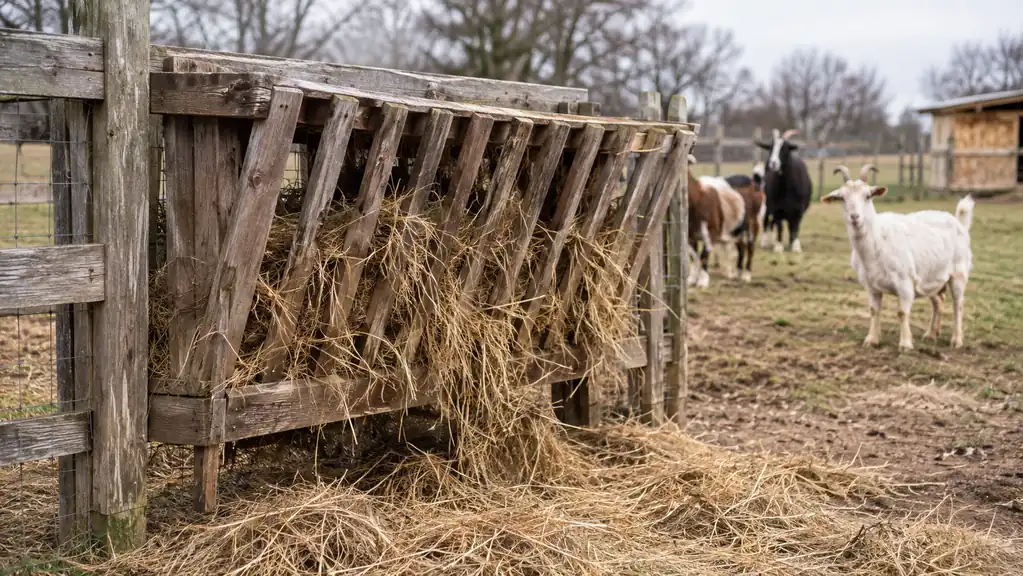
Capacity, and I will not pretend otherwise. My rack held a full flake and often more, and I could top it off every second or third day. The net holds plenty for three does, but it is a daily job once the grass goes, and if Ron and I are gone overnight I have to hang a second net or ask him to fill the one that is up. If you keep a dozen goats, or you work long shifts, that daily fill is the thing that will wear you down first.
A rack is also easier when several animals eat at once. Mine was wide enough that all three does could stand at it shoulder to shoulder without shoving. With the net, two can nose in comfortably and the third waits her turn. That is fine in a small herd and it would not be fine in a big one, where the boss doe parks herself at the net and everybody else gets what is left. And filling a rack is one motion. Filling a net is a stuff and a tie, with both hands, standing in the cold.
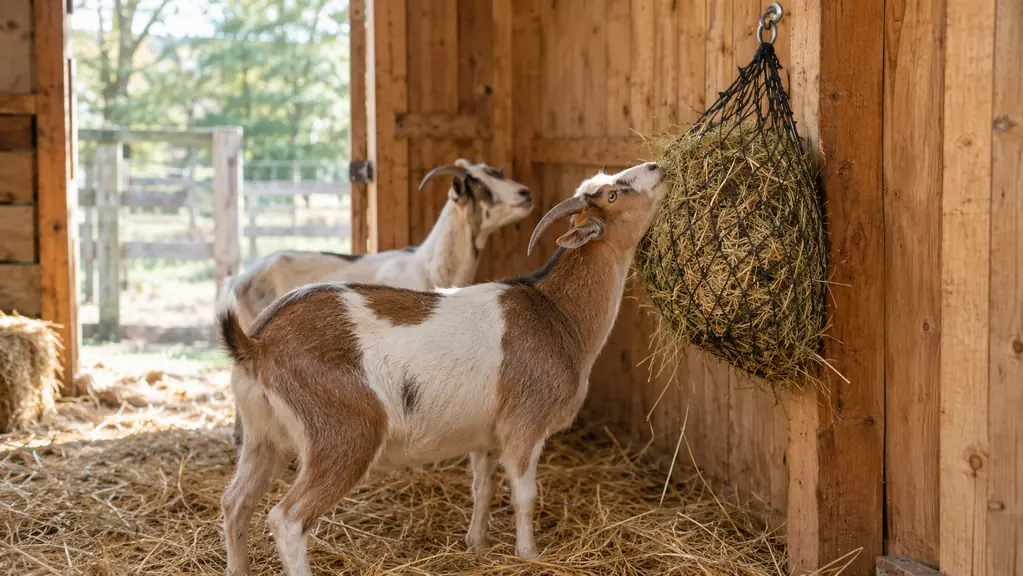
Three does, one net, and about half the hay on the floor
The Tough 1 Slow Feed Hay Net hangs from a single eye bolt and holds a day's hay behind two inch knotted openings. It is what is on my shed wall right now.
Amazon Check Today's Price on Amazon →What the Net Actually Is, and How I Hung It
The Tough 1 Slow Feed Hay Net is a polyester mesh bag with knotted two inch openings, made to hold hay. The listing calls it a horse product and lists shows and trailers among its uses, which tells you the size range it was built for. It weighs a hair over nine ounces empty and rolls up small enough to sit in a feed bucket. Mine has been hanging in a goat shed since November 2024 and it has not torn.
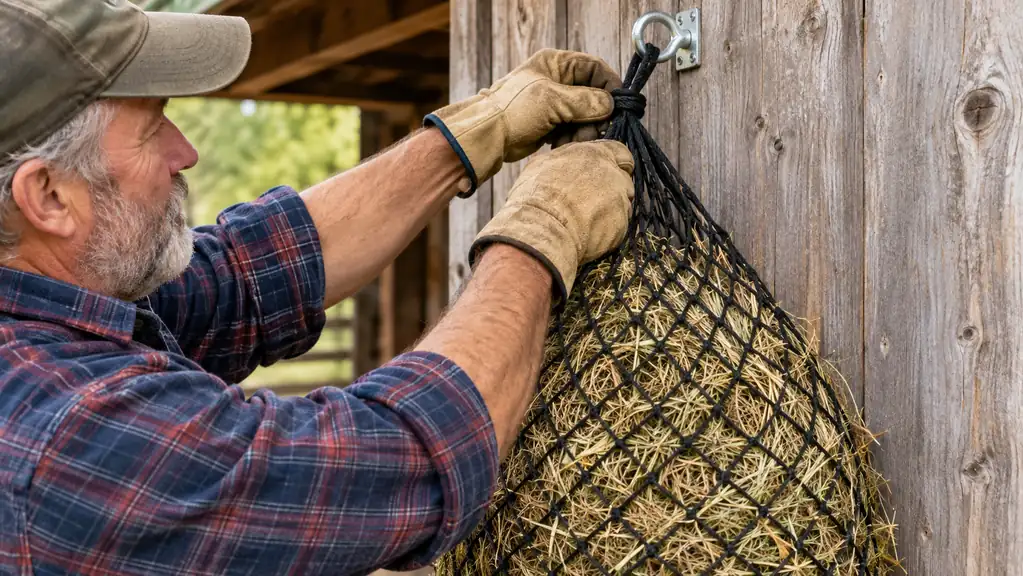
Hanging it right took one try and a little thought. I put a sturdy eye bolt into a wall stud at about the height of the does' heads, ran a length of twine through the top of the net, and tied it off. Then I gathered the bottom and pulled it up and tied that off too, so the bag hangs in a bundle instead of dangling near the floor. That part is not optional in my book. A net hanging low is a net a goat can put a foot through, and a goat with a foot caught in mesh is how you end up on the phone at nine at night. The first time I hung it I put the eye bolt too low, about knee height on me, and Clover got her nose under the bottom and pushed it around until hay was coming out the top. I took it down, measured up from the floor to the top of Pepper's shoulder, and moved the bolt up to a little above that. The twine through the top of the net and the bottom gathered and tied made the difference. It has hung at that height ever since.
My does are disbudded, so I do not have horns to plan around. If yours have horns, hang the net higher than you think you need to and look it over every single day, because a horn through mesh is a wreck I do not want to describe. The other thing I watch is the twine. The polyester mesh holds up fine, but the twine I tied it with does not, and I have re-tied it twice when it frayed through.
I was pitching a wheelbarrow of trampled hay out of that shed every week. Now it is closer to half of that, and the floor under the net stays clean enough to walk on.
What Changed Over a Winter
Winter is the real test. From December through February the does are on hay almost entirely, and that is when an open rack turns into a mess. With the net I fill it in the morning, and it lasts the day. The floor stays cleaner, the bedding lasts longer, and I am not out there in the cold pitching soiled hay three times a week like I used to be. The cold snap in January 2025 was the worst of it. The net froze stiff one morning and I could not work hay into it until I brought it inside by the wood stove for an hour. A rack does not freeze shut the same way, but the hay in it froze into a block, so neither one came out of that week looking clever. What I did learn is that a net under a roof is fine, and a net hanging in the weather would be a chore.
The net handled the weather better than I expected, mostly because it lives under a roof. On a damp cold morning the hay inside can go a little limp, and there was one week where it was stiff enough that I had to work it loose with my hands before I could fill it. A rack has the same trouble with the hay on the outside of the pile. Neither one fixes damp. Both need cover.
The thing I did not anticipate is that the net makes it easy to see how much they are eating. A rack always looks half full. A net goes flat as it empties, so if it is still bulging at dusk I know something is off. Maybe a doe is off her feed, maybe the hay is stemmy and they are sorting it and leaving the rest. That has told me something useful twice this winter, and I would not have caught either one with a rack.
The Parts Nobody Warns You About
Filling a net is slower than filling a rack, and it is slower in the cold with gloves on, which is exactly when you will be doing it. Two minutes means nothing in July. Two minutes at six in the morning in January is a different calculation, and I will not pretend I have never muttered about it.
It also does not scale. Two goats can eat from mine at once. Three crowd it. If I had eight does I would need two nets, and at that point I would be hanging hardware all over the shed wall and I would probably go back to a rack with a tray underneath to catch what drops. One morning in February all three came in at once and Pepper, who is the youngest and the lowest in the order, stood back and watched for ten minutes before she got a turn. She got her share, but she had to wait for it, and I stood there longer than I wanted to make sure she did.
And mesh does not last forever. Mine is holding up, but I have seen netting go brittle after a couple of seasons in full sun, and a net hung outdoors in the weather will not last like one under a roof. Keep it out of direct sun if you can, and check the mesh at the bottom where the hay sits heaviest. Ninety days is what the maker guarantees, which tells you to look it over yourself.
Who Should Buy Which
Buy the Tough 1 Slow Feed Hay Net if you keep a small number of goats, if waste is the thing that irritates you, and if you are already out there once a day anyway. That is my situation exactly, three dairy does in a converted shed, and it fixed the specific problem I was mad about. It is also the one to buy if you haul animals or go to shows, since it packs down to nothing.
Buy a hay rack if you keep more than a handful of animals, if you need two or three days between fills, or if you want everybody eating at once without a pecking order squabble. There is nothing wrong with a rack. It is a good tool for a bigger herd and a worse tool for a small shed with a sweeping problem. Plenty of people run both, a rack for volume and a net for the ones that need slowing down.
If you want the longer version of how this net has held up, I wrote about it separately: the long-term notes after months of daily use, the waste math that finally convinced me, and the week I got tired of the rake. Start with whichever one sounds like your shed.
Hang it from one eye bolt and see what your floor looks like in a week
The Tough 1 Slow Feed Hay Net holds a day's hay behind two inch knotted openings and rolls up small enough for a trailer. Mine has been on the wall since November 2024.
Amazon Check Today's Price on Amazon →