I lost two hens on a Tuesday evening in September 2024. Ron and I were late getting home from Siler City, and when I walked down to the walk-in coop with the feed bucket, the pop door was still open. Feathers were scattered along the fence line. A fox had been through. I had 16 hens that week. I have 14 now.
That is the short version of why I bought the NyPots Automatic Chicken Coop Door. Not because I wanted a gadget. Because I was tired of doing the math on what one late evening could cost. I mounted it on the pop door of our wooden coop, put the solar panel on the roof, and let it run. It has been on that coop since September 2024, through cold mornings, cloudy stretches, and more than a few nights when I got home after dark.
The Quick Verdict
A plain, dependable door that closed a gap in my routine. It has not missed a dusk since I set it, but it is not a security system and it will not fix a drafty coop.
Amazon Check Today's Price →The one change that let me stop rushing home before dark
NyPots makes a solar-powered door with a timer and a light sensor. I mounted ours on the pop door, set the mode, and quit planning my afternoons around sunset. Check the opening size before you order.
Amazon See the current listing on Amazon →How I've Used It
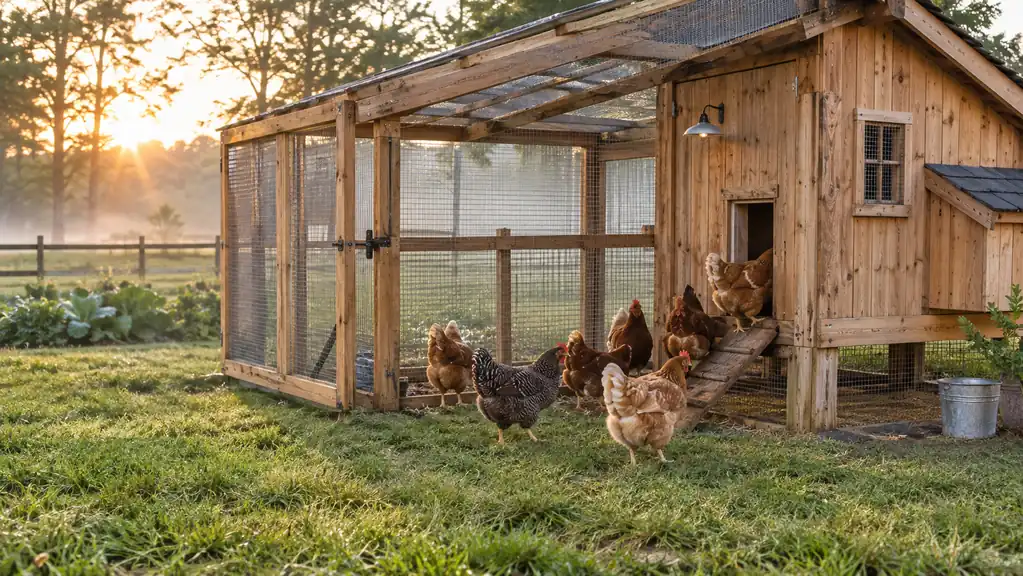
Our coop is a walk-in wooden building with a covered run attached. The pop door is the only way in or out for the hens. Before the NyPots door, that pop door had a simple slide latch I opened after breakfast and closed at dusk. If we went to town for supper, I either hurried back or asked Travis to drive out from Raleigh, which is not a real plan.
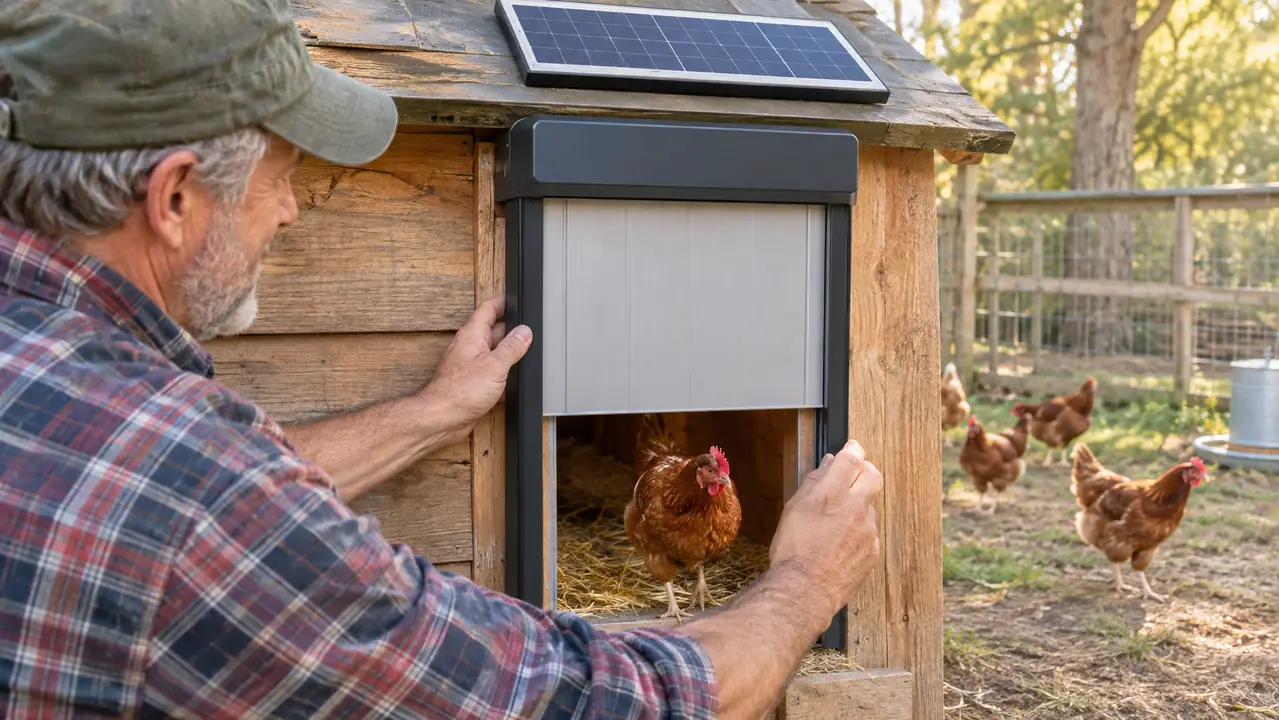
The install was a Saturday morning job. The box had the door unit, a solar panel, a charging cable, a screwdriver and eight screws. I lined the door up over the existing opening, marked the screw holes, and Ron held it steady while I drove them in. I drilled pilot holes first, because old barn wood splits if you drive a screw into it cold. That cost me ten minutes and saved me a cracked frame. The unit measures 9.6 by 1.6 by 13 inches overall and is listed at 1.6 pounds, so it sat flat against the face of the pop door once the screws were snug. I checked it for wiggle with my hand before I ever hooked up the panel. The opening on our coop was already close to the size the door needs. NyPots lists the clear entrance at 8.2 inches wide and 9.6 inches high. That last number matters if you are mounting it on a thin frame. Ours is old barn wood, so it had plenty of meat to bite into.
I did not have to cut a new hole. The frame fit over the opening we had. If yours is smaller or larger, measure first. The clear entrance of 8.2 inches wide and 9.6 inches high is the number to check. A pop door that is too small will not give the hens a clean lane in and out. Ours has a little step, and the hens manage it fine.
I ran the solar panel up on the coop roof where it gets sun most of the day. The charging cable reached that far. I set it to light sensor mode first because that is the mode that matches how I think about dusk. Later, when we hit a stretch of gray mornings, I switched to timer mode for a few weeks. I have not had to touch it since.
What the NyPots Door Actually Does
The NyPots door is simple in the way I want barn equipment to be simple. It opens. It closes. It does that on a light sensor or on a timer you set yourself. The listing also mentions a manual mode, which lets you bypass the automation and run it by hand. I have used manual mode twice, once when I was cleaning the coop and once when I was moving hens after dark. It is not complicated.
The timer side has a T-T mode. You set the open time and the close time. For example, open at 07:00 and close at 07:00. I used that in January when the light sensor was opening later than I wanted. The hens were up and itching to get out before the sensor thought it was morning. Timer mode got them out on schedule. I switched back to the light sensor once the days stretched out again.
The light sensor mode is the one I leave alone. It watches the light and opens or closes accordingly. That sounds obvious, but it is the reason I stopped thinking about the door at all. In the summer, it opens early. In the fall, it opens later. I am not standing there with a flashlight checking my watch.
What it does not have is a bunch of features I would never use. There is no app to open in the dark, no remote to lose in the feed room, and no screen to fog up. It is a door, a panel, and a setting you choose. That is the whole thing. If you want a door that talks to your phone, this is not that door. If you want a door that closes while you are still in the house, it is.
Mornings, Evenings, and the Light Sensor
The morning change was the one I noticed first. Before, I was out there in my robe and mud boots, sliding a wooden door open while 14 hens pushed past my legs. Now I pour coffee, look out the kitchen window, and the door is already open. The hens are in the run. Nobody is standing in the dark waiting on me.
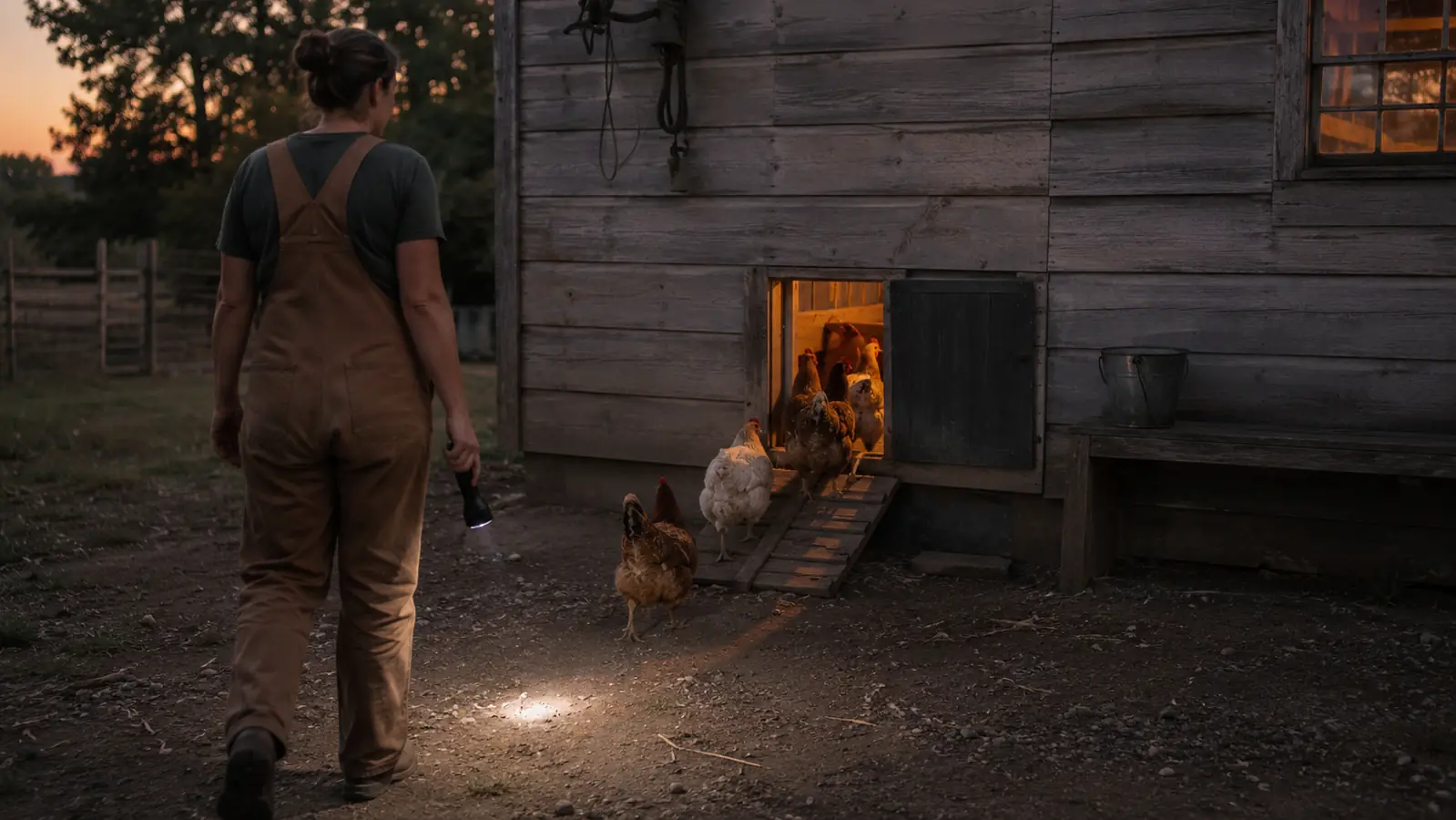
The evening change is the one that matters more. Our fox problem was not a morning problem. It was a 6:45 p.m. problem in September, when the light goes early and supper runs late. The door closes on the light. I still walk down at dusk with a flashlight and count heads. I count them because I am not going to trust any machine with the whole job. But the door has already done the part that I used to forget.
Take the second Saturday in October. We drove over to Asheboro for a cousin's birthday supper and did not get back until nearly ten. I walked down with the flashlight expecting the worst and counted all 14 hens through the wire, every one of them inside. Two years ago that same evening would have meant an open pop door and a fox working the fence line before we ever pulled in the driveway. That is the whole case for the door, and it is a plain one.
That is the honest split. The NyPots door handles the timing. I handle the count. A door cannot tell me that one hen stayed out in the run because she was broody, or that one is sitting in the nest box after dark. It closes an opening. It does not count birds. Anybody who tells you an automatic door replaces a dusk walk is selling you something else.
The door closes on the light. I still walk down at dusk and count heads. That is the deal, and it is a good one.
Winter, Cloudy Mornings, and Timer Mode
Our first winter with the door was a test. Not a brutal one, we are in central North Carolina, but we get mornings that stay gray until nine and cold snaps that make the metal latch on the goat shed stick. The solar panel on the coop roof does not get much help on those days. That is when I switched to timer mode.
There was one morning in January when I went out at seven and found a skin of ice on the panel and the door still shut with 14 hens fussing behind it. I wiped the glass with my glove, and it opened a few minutes later. Nobody was hurt and nothing was broken, but that was the morning I quit trusting the sensor in cold weather and set the timer instead. I would rather have the door open at a time I chose than stand in the run guessing at the sky.
I set the T-T mode for a fixed open and close and left it there for a few weeks. The hens got out when I wanted them out, not when the sky got around to it. I did not have to stand in the run at 7:30 with a flashlight, waiting for a sensor to decide it was morning. When the days got longer, I put it back on the light sensor. That has been the pattern since. Light sensor most of the year, timer mode for the short gray stretch.
The one thing I watch is the panel. If snow sits on it or if the roof gets shaded by the big oak after a storm, I clean it off. A solar door needs sun. Ours gets it. If your coop sits under trees all day, think about where you put the panel before you mount anything.
I also check the panel after a storm. We have a big oak on the east side, and when the wind strips leaves they stick to the glass. A quick wipe with a rag is part of my morning walk. That is not a complaint. It is the same sort of maintenance I do on the goat shed latch and the feeder lid.
Predators, Head Counts, and What the Door Does Not Solve
We lost two hens to a fox in September 2024. Since the NyPots door went on, we have not lost a hen to a predator. I am not going to write that as a guarantee. A door closes one opening. It does not fix a gap in the run wire, a loose board, or a raccoon that has learned to work a latch. We still walk the fence line. We still lock the run gate.
The closest call since then was a broody hen that parked herself in the nest box well past dark. The door had already shut and she was inside, which was fine. Had she been out in the run instead, she would have spent the night out there. That is not the door failing. That is the reason I still take the walk with the flashlight instead of watching it from the kitchen window.
The door has also made the evening routine shorter. I used to wait until full dark to close up, because I did not want to shut a hen out. Now the door closes when the light goes, and I go down with the flashlight to count. If a hen is missing, I know it before I go to bed. That is not nothing. It is the difference between finding a problem at 7:30 p.m. and finding it at breakfast.
What it does not solve is everything else. It does not keep the coop warm. It does not stop a draft. It does not replace the waterer or the feeder or the bedding. It is one piece of the routine. I still fill the feeder about once a week. I still check water. I still clean the coop. The door just means I am not doing the pop door dance twice a day.
I also had to get used to the sound. It is not loud, but it is a mechanical sound, and the first week I heard it from the house and went down to check. Now I do not notice it. The hens got used to it faster than I did. They line up at the opening when it starts to move.
What I Liked
- Opens and closes on a light sensor without me touching it
- Timer mode, including the T-T setting, is useful on short winter days
- Solar panel on the coop roof means no cord running across the yard
- Clear entrance is 8.2 inches wide and 9.6 inches high, enough for our hens
- The unit is listed at 1.6 pounds, so it did not strain the old pop door frame
- Included screws and screwdriver meant no extra trip to the hardware store
- Manual mode is there when I need to override it
Where It Falls Short
- It is a door, not a whole-coop predator barrier
- The light sensor can open later than I want on gray mornings
- Panel placement matters; shade or snow slows it down
- No app or remote, if that is what you are looking for
- I still do a head count every dusk
- Measure your pop door frame before ordering, because the opening size will not fit every coop
Who This Is For
This door is for a keeper who has a walk-in coop with a pop door and a routine that keeps getting interrupted. If you work late, if you want to go to supper without watching the clock, if you have lost birds to a predator because you were not home at dusk, this is the kind of fix that pays you back in peace of mind. It is also for someone who wants a simple control, not a phone app. The NyPots door is a good fit for a small flock. We have 14 hens. It would handle that all day. If you are gone for a long day and come home after dark, this door does the one job you cannot do from town.
It is also a good fit if your coop gets sun. The panel needs light. If your coop is under heavy shade, plan where the panel goes before you order. And measure the opening. The clear entrance is 8.2 inches wide and 9.6 inches high. Our pop door was close enough. Yours might not be.
Who Should Skip It
Skip it if you want a door that also locks, alarms, and reports to your phone. This is not a security system. It is an automatic door. It closes an opening. It will not tell you a raccoon is on the roof.
Skip it if your coop is in full shade and you are not willing to run the charging cable or move the panel. Skip it if you are not going to walk the fence line and do a head count. The door does its job. It does not do yours.
A small door that gave me my evenings back
If you are tired of planning your day around the pop door, the NyPots door is the version I bought and kept. Check the opening size against your coop, pick your mode, and do your own dusk count. That is the whole system.
Amazon See the current listing on Amazon →