
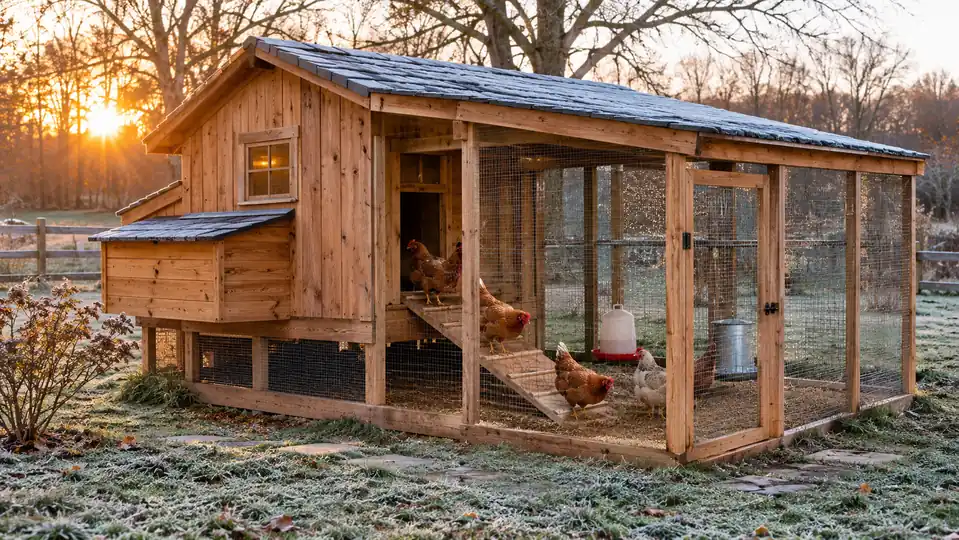
Two hens gone in the time it took to finish supper. That was September 2024, a mild evening when Ron and I got home later than we planned, and the pop door on the walk-in coop was still standing open at full dark. A fox does not need long. I found the feathers along the fence line and did the arithmetic every keeper ends up doing: sixteen hens that morning, fourteen that night. Within the week I had ordered the NyPots automatic coop door and mounted it on the same pop door I had been sliding shut by hand for five years. I have not lost a hen to a predator since it went on.
Here is the short answer, from somebody who has latched a coop in the rain and now lets a small solar panel on the roof do it. The NyPots door earns its place if your problem is the closing, meaning the evenings you are late, worn out, or away overnight. A manual latch earns its place if your problem is money, or if you are home at dusk every day of the year and the walk out to the coop is part of your evening. This is not good against bad. It is a machine that closes on schedule against a person who mostly does.
| NyPots Automatic Coop Door | Manual Latch | |
|---|---|---|
| Closing time, every night | Follows the light sensor or the timer setting you chose, whether you are home or not | Follows whoever walks out and slides the latch |
| Late evenings and travel | Closes itself while you are still on the road | Waits for you, and a fox does not |
| Protection at last light | No open doorway at dusk, which is when predators work | Only as reliable as the person remembering |
| Upfront cost | Money out of pocket this month | Nothing to buy if the coop came with a latch |
| Installation | Screws to the pop door with the included screwdriver and eight screws | Nothing to install |
| Parts that can quit | Solar panel, charging cable and a door that slides | A latch and a hook |
| Heavy overcast mornings | The light sensor can open late, which is why I switch to timer mode for a few weeks in winter | You open it when you get there |
| Opening size | 8.2 inches wide by 9.6 inches high, for birds under ten pounds | Whatever opening you built |
| Counting heads at dusk | Still your job | Still your job |
Where NyPots Wins
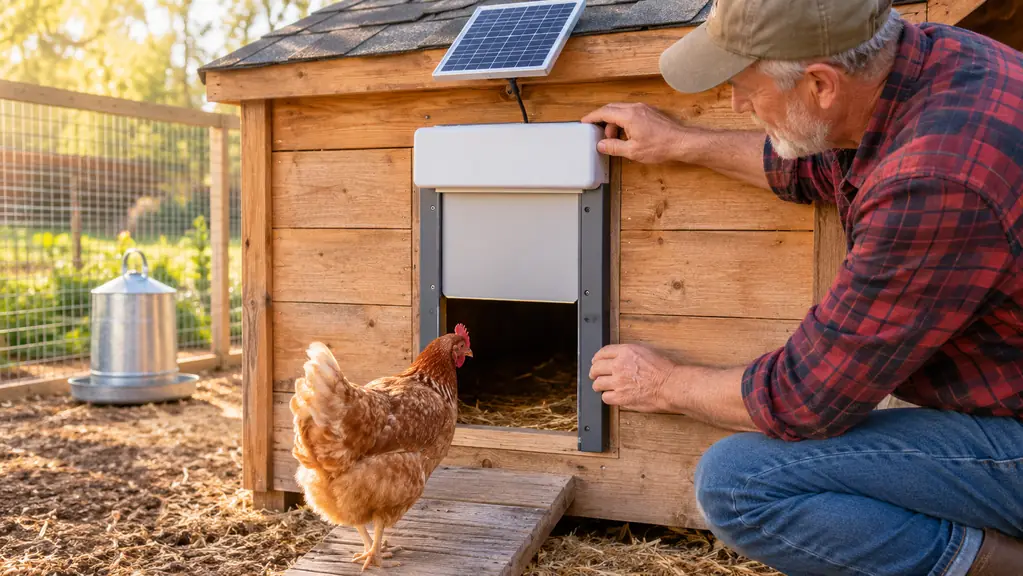
The closing is the whole thing, and it is worth being plain about why. My old routine was a slide latch and a hook, and it worked fine on every evening I was standing there at dusk. The trouble was the other evenings. NyPots runs on a light sensor through most of the year, so the door follows the sky instead of my supper dishes, and there is a timer mode for the stretches when the light cannot be trusted. There is no outlet in my coop and there never will be, so the panel on the roof does the charging. The box came with the panel, a charging cable, a screwdriver and eight screws, and the whole job took me one afternoon including the trip back to the shed for a level.
Late nights are the other half of it. Ron is a retired lineman and still gets called out when a line goes down, and I have driven to Raleigh to see Travis and come back well after dark more than once. That trip is about an hour and a quarter each way, so if I leave after supper I am not home before ten. With the latch, a late evening meant calling a neighbor or leaving the coop standing open until I got home, and one of those two options is how you lose hens. With the door, the evening takes care of itself. I still walk out at dusk and count heads, and I would tell anybody to do the same, because a door that closes is not a door that counts. But my count has turned into a check on the flock instead of a scramble.
The fitting was simpler than I expected. The unit measures 9.6 by 1.6 by 13 inches and weighs about a pound and a half, and the opening it leaves for the birds is 8.2 inches wide by 9.6 inches high, sized for poultry under ten pounds. My Buff Orpingtons are the widest birds in my flock and not one of them has ever had to squeeze through. It screws onto the pop door you already have, which means the hole in the coop does not have to change. I put the eight screws into the pine frame of my pop door rather than the siding, and I predrilled every hole, because that frame is old and will split if you look at it wrong. There is also a manual mode that lets you bypass the automatic side and run the door yourself, and I used that for the first two evenings while I stood in the run holding a coffee I never drank, waiting to see whether the panel would catch on the frame going down. It did not.
What I did not expect was how quickly it stopped being interesting. For the first month I checked it every night the way you check a new fence post. By November I was checking the hens and not the door. The first night it truly earned its keep was a cold one in December, when Ron got called out around nine and I was inside with the woodstove going and no intention of pulling boots back on. The door had shut at dusk and I never touched it. That is the honest measure of a piece of equipment on four acres: it becomes part of the barn, the way the latch did, except this one keeps working on the nights I forget.
Sixteen hens that morning, fourteen that night. That is the entire reason a door on a light sensor lives on my coop now.
Where A Manual Latch Wins
The latch wins on simplicity, and I am not going to dress that up. Mine came with the coop: a slide bolt at the top and a hook below it, both plain steel, and when the hook got stiff I put a drop of oil on it once a season. There was nothing to buy, no charging cable to keep up with, no panel to wipe clean and no setting to think through. If you are just starting with four hens behind a suburban fence, or if this spring is going to fencing and feed instead of hardware, a latch and a solid hook will keep a flock safe for years, provided you use them. Plenty of people do exactly that, and they are not wrong to.
It also wins on grey mornings, which is the one thing about the automatic door that still makes me grumble. Last winter I switched it to timer mode for a few weeks because heavy overcast was opening it later than I liked, and that solved it, but it was me adjusting a machine to cover for a machine not reading the sky the way I would. A person standing at the coop at six in the morning with a cup of coffee knows whether it is properly light out. A sensor sitting on a roof is making its best guess from where it happens to be mounted. The week I switched it, we had four days of flat grey that never really got bright, and the hens were stacked up at the pop door at seven waiting to be let into the run while I stood there feeling foolish about the whole arrangement. Timer mode fixed it in about a minute of fiddling, and I have set it that way every winter since.
And the latch fits whatever you built. My pop door is a plain rectangle and the NyPots opening suited it, but if your coop has a wide doorway for a big flock, understand that 8.2 inches is a fixed number and your doorway is not. A latch does not care what shape the hole is. It also has nothing in it that can quit in the cold, which matters a great deal more in February than it does in May. I have stood in the run in February with a flashlight in my teeth working a stiff hook loose, and I would still rather do that than wonder whether a panel buried under ice is doing its job.
There is one more thing, small but real. A latch needs no instructions. When I am sick, or when Ron is, or when a neighbor does the evening check because we are both away, nobody has to learn a control sequence to shut a coop. The door is not complicated, but it is one more thing somebody has to understand that a hook is not.
The closing is the part you cannot do from Raleigh
Light sensor for ordinary evenings, timer mode for the grey stretches, and a manual mode for the days you want to run it yourself. It screws onto the pop door you already have, with the panel, the charging cable, the screwdriver and eight screws all in the box.
Amazon Check Today's Price on Amazon →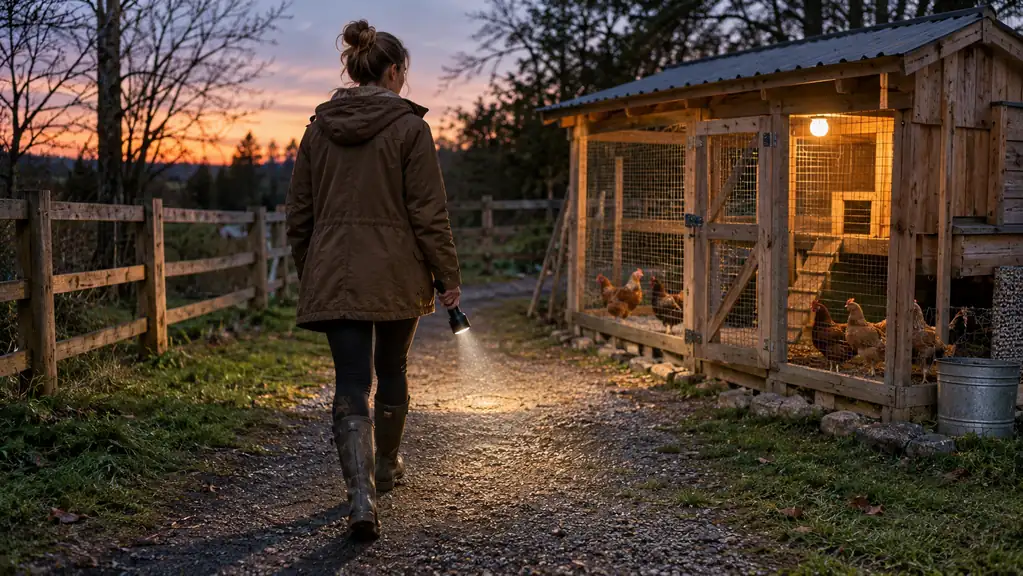
Who Should Buy Which
Buy the NyPots door if the closing is your weak point. That means you work late, you travel, you have family obligations that run past dark, or you have already had a predator visit and you do not intend to have a second one. It suits anyone whose coop is a walk from the house, because the walk at ten at night in January is the one that gets skipped. At 4.3 stars across a couple thousand reviews, plenty of keepers have reached the same conclusion I did, and most of the complaints I have read are about the light sensor on dark mornings, which is fair and which timer mode handles.
Stay with a latch if you are home at dusk most nights, if the coop is twenty steps from your kitchen door, or if this is your first season and you want to learn your flock before you automate anything. There is nothing wrong with a latch. I used one for five years and the only night it failed was a night I failed. I got home at eight-thirty that evening with a pot of soup still warm in the truck, and the coop was open, and that was not the latch losing track of the time. If the money this month needs to go to fence, feed or a vet visit, the latch is the sensible choice and the hens will not know the difference.
Before you buy either, check three things. First, measure your pop door, because the NyPots opening is 8.2 inches wide by 9.6 inches high and the birds using it need to be under ten pounds. I measured mine twice with a carpenter's square before ordering and then a third time with a tape because I did not believe the first two. Second, look at where the sun lands on your coop roof, since the panel needs light to do its job. My roof sits in shade until about nine in the morning from November through February, which is exactly why timer mode exists. Third, be honest about your evenings, because if you are home at five every day and you like the walk down, you would be buying a fix for a problem you do not have. I would rather say that out loud than have you find it out afterward.
If you do buy it, keep the latch. I did not take mine off. The door has a manual mode that bypasses the automatic side, so if the panel gets buried in snow or I want the pop door shut early ahead of a storm, I can still run it by hand. That is not a flaw in the product. That is how a farm works. You keep the simple backup and you let the new thing handle the ordinary nights.
One last thing and then I will get out of your way. The night I lost those two hens, I told myself I would fix it properly, and then I spent a week telling myself a latch was fine. It was fine. It was fine right up until it was not. If your evenings look anything like mine did in September 2024, that is the whole argument, and you can take it from a woman outside Siler City who counts fourteen hens every night and intends to keep counting fourteen.
Fourteen hens, one door, and nobody has to leave supper to shut it
If the evenings are your problem, this is the fix I use. Check the opening against your own pop door first: 8.2 inches wide by 9.6 inches high, for birds under ten pounds.
Amazon Check Today's Price on Amazon →