
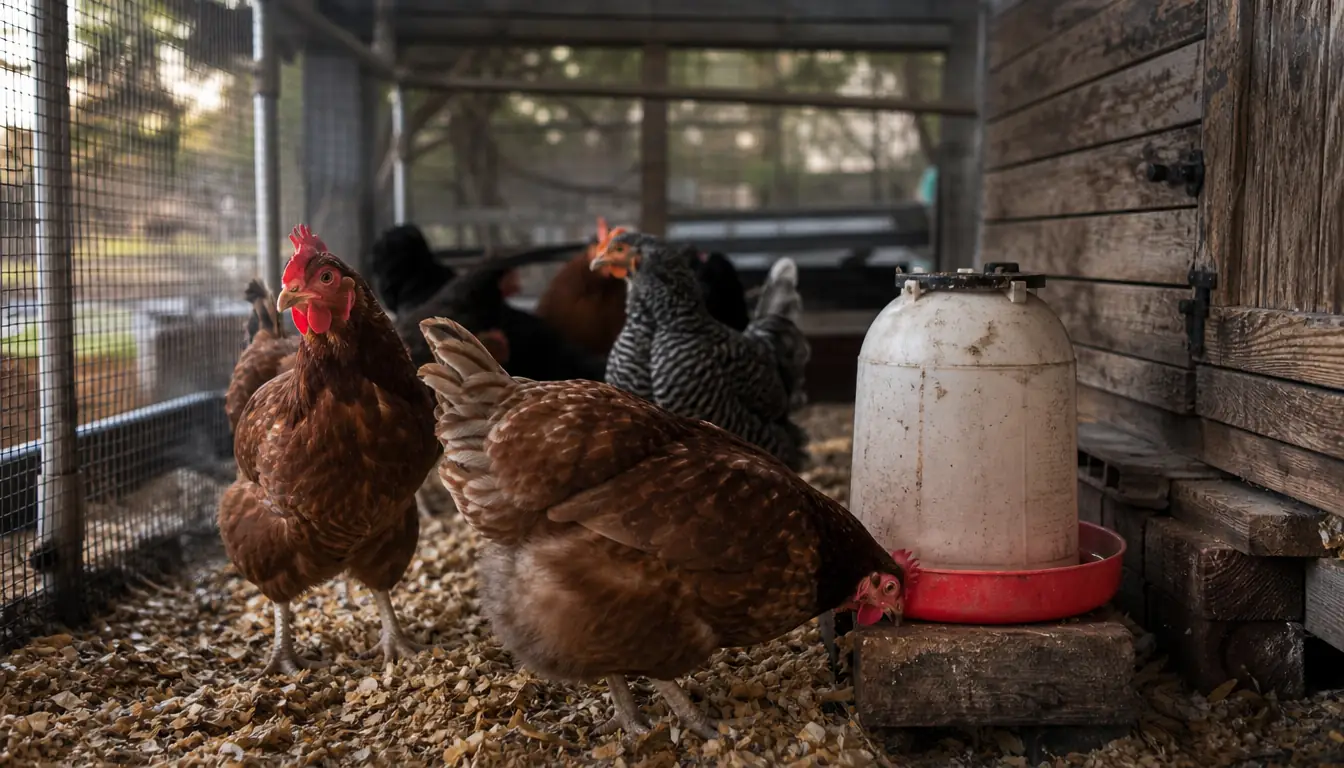
I did not want to like this waterer. I bought the Harris Farms Easy-Fill Poultry Drinker in March 2024 for one reason, which was that I was hauling two small waterers out to the covered run twice a day and my shoulder had started complaining about it. Fourteen hens, a walk-in coop, and a woman of fifty-seven who had done the math and did not care for the answer. That is the whole backstory. What follows is what I found out after the box was open, including the parts I wish somebody at the feed store had mentioned while I was still holding it.
The short version first. The drinker holds 6.25 gallons, fills from a lid on the top with a garden hose, and a float valve inside keeps the trough at a steady level so nobody is flipping a full reservoir upside down and hoping. In my run that works out to a refill about every four days in July and closer to once a week from November through February. What it does not do is clean itself, stay liquid through a hard freeze, or forgive a spot that is not level. It is a good tool with a short list of real drawbacks, and whether it fits your barn depends entirely on which of those drawbacks you can live with.
The Quick Verdict
A genuinely easier refill than any jug waterer I have owned, with a short but real list of complaints a buyer should hear before the box arrives.
Amazon Check Today's Price →The refill is the part that sells it
Top-fill lid, a hose, and about four days of water for a flock my size. If carrying water is the chore you want gone, start here.
Amazon Check Today's Price on Amazon →How I've Used It
The drinker sits on two stacked cinder blocks in the covered run. That puts the trough at roughly the height of a hen's back and keeps most of the pine shavings from being kicked into the water. The height mattered more than I expected. My first week I set it on the ground, and I was out there every afternoon scooping litter out of the trough with two fingers. On the blocks I scoop maybe once or twice a week, and usually that is one enthusiastic hen rather than an actual problem. Two standard cinder blocks stacked come to about sixteen inches, which is the number you want if you are copying my setup. Do not use a single block and call it done. A single block puts the trough low enough that a determined hen can still get a foot in it, and I know that because I tried it first.
The hens took to it in about an afternoon. No training, no trick, no standing around waiting for them to figure it out. The trough sits at a comfortable height, the water is right there, and fourteen birds had it sorted before supper. The only one who needed convincing was a Buff Orpington who insisted on standing in it for the first three days, which is why the blocks are stacked high enough now that stepping in is awkward.
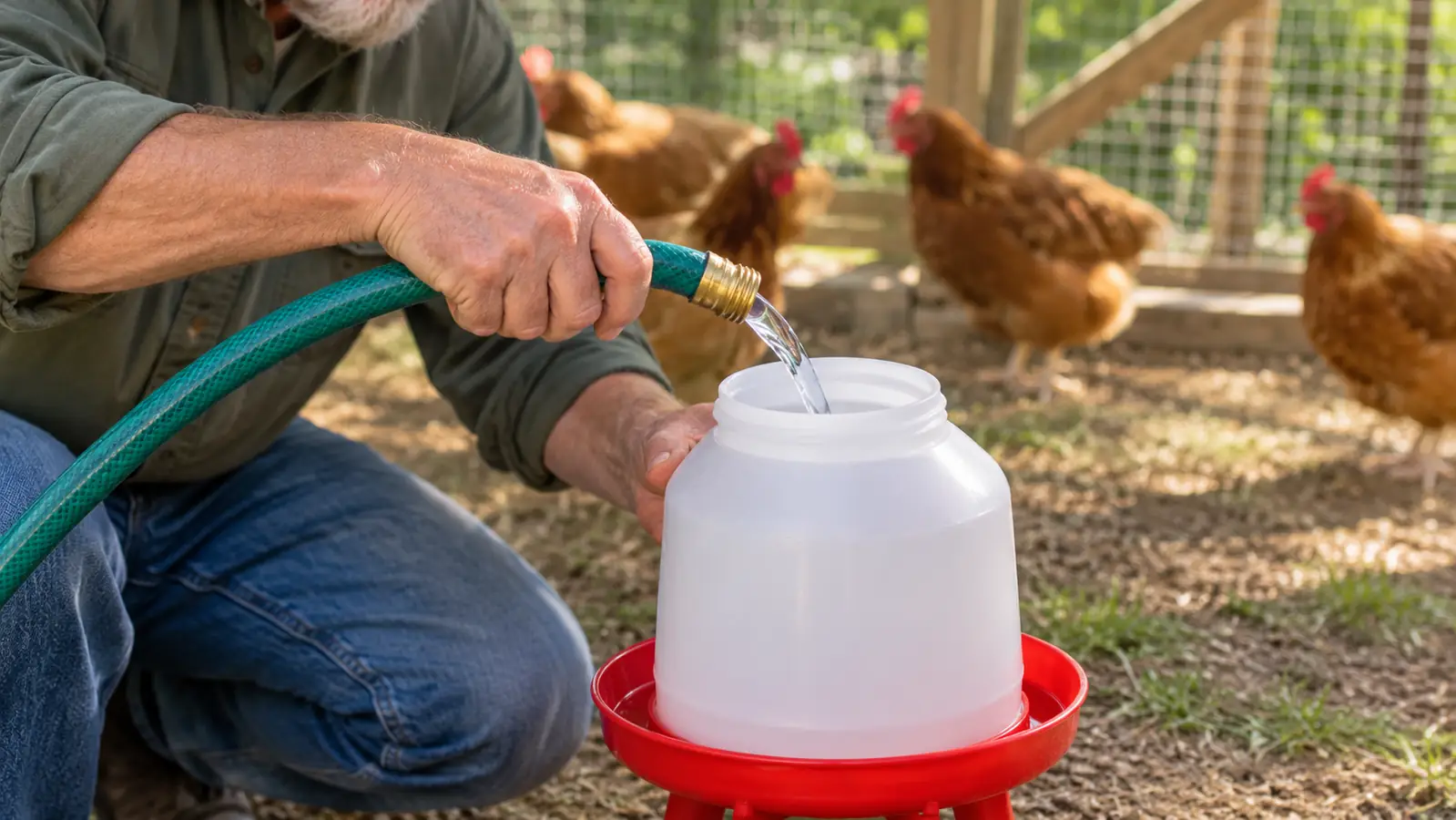
Refilling is the part I still notice, in a good way. I drag the hose over, open the lid on top, and let it run while I deal with the feed. No lifting, no carrying, no setting a full waterer down hard and sloshing half of it into the shavings. In July, 6.25 gallons lasts my fourteen hens about four days. In cooler weather it stretches to something closer to a week, and there have been February stretches where I went longer than that without thinking about it. My hose reaches about thirty feet from the spigot on the north side of the coop, and that is the single thing that made this work. If your spigot is on the far side of the house, you will want another hose before you want another waterer.
Cleaning is on me, not on the drinker. Every couple of weeks I lift it off the blocks, dump what is left, and scrub the inside with a stiff brush and a vinegar rinse before refilling. In July it wants that more often. Anything holding standing water in a North Carolina summer grows a slick film on the walls, and plastic does not exempt you from that. Nobody mentioned it at the store, so I am mentioning it here. The first time I let it go a full month, in June 2024, the water smelled faintly of pennies and I dumped the whole thing and started over. Do not do what I did. Ten minutes every other week is cheaper than losing a week of eggs to birds that will not drink.
That first week also taught me about level. One corner of my block stack was low by about a quarter inch, which was enough for the float valve to sit slightly open and keep a thin trickle running. I shimmed it with a scrap of pine and the problem went away. If you set this on uneven ground or a sloped concrete pad, plan on fixing the surface before you fill it, because the valve is doing exactly what it was built to do and it will not compensate for a tilt. I keep a four foot level in the shed now and I check the top of the blocks every spring, because frost heave moves things and a quarter inch is all it takes.
What Nobody Tells You Before You Buy
The float valve cuts both ways, and the listing does not say so. It holds a consistent level, which is the entire point and it works, but by design the trough stays shallow. A hen who steps into it, or drags a beak full of mash through it, fouls the whole drinking surface until I rinse it. A deep open bucket would hold more water and stay dirty longer. Neither is better. They are two different jobs and you should pick based on which failure annoys you less.
Winter is the big one. In January 2025 we had a cold snap that took the drinker solid, plastic and float together, and I came out to fourteen hens standing around a block of ice and looking at me like I had arranged it personally. The thermometer on the shed wall read eleven degrees that morning and it had not been above freezing in three days. I keep a heated base under it now for the cold months. The base is not part of the drinker and it is not something this product does. If your winters go hard, plan for that expense separately, because a gravity-fed plastic drinker is not a heated waterer and no amount of wishing changes the chemistry.
It holds 6.25 gallons and the unit itself weighs 4 pounds empty, which is nothing. Once it is full it is not something you carry around the yard, though. Mine lives in one spot, and if you were picturing yourself moving it out to a pasture pen every morning, you will stop doing that by the second week. Buy it for a fixed setup or do not buy it at all.
The lid is the smallest complaint and the one I think about on the most mornings. It is a top-fill lid and it does exactly what it says, but on a windy March day I have chased it across the run twice. That is a me problem as much as a product problem, and I would still rather have a lid I can chase than a reservoir I have to flip. My fix was a concrete block laid on top while I fill, which sounds silly and works.
Refilling takes about a minute with a hose. Scrubbing it takes about ten minutes every other week. That is the real trade, and I would make it again.
How It Compares to the Jug Waterers I Had Before
Before this I used two of the standard plastic jug waterers, the kind you fill, screw a base onto, and turn over. They are not bad. They are just work. Filling one means carrying a full container across the yard, and turning it over means a certain amount of water on your boots every single time. Two of them got me through about a day and a half in August, which is why I was making two trips a day. The Harris Farms drinker replaced both, and I have not gone back.
The difference is not subtle in daily use. One chore, once every four days, against two chores, twice a day. Over a summer that is the difference between roughly twenty refills and something north of two hundred. Ron did the arithmetic on the back of an envelope one evening and then did not believe it and did it again. I have not missed the jugs. I have missed the fact that a jug could be carried to a sick pen, which this cannot, so I kept one in the shed as a backup and I would suggest you do the same.
Where the jugs win is portability and the cost of getting started. If you move your birds around, rotate pens, or only keep four hens, a jug waterer is honestly the right answer and this is more capacity than you need. I would not talk a four-hen keeper into a 6.25 gallon drinker. I would talk a fourteen-hen keeper into one without hesitating, and then I would tell them about the blocks.
What It Actually Gets Right
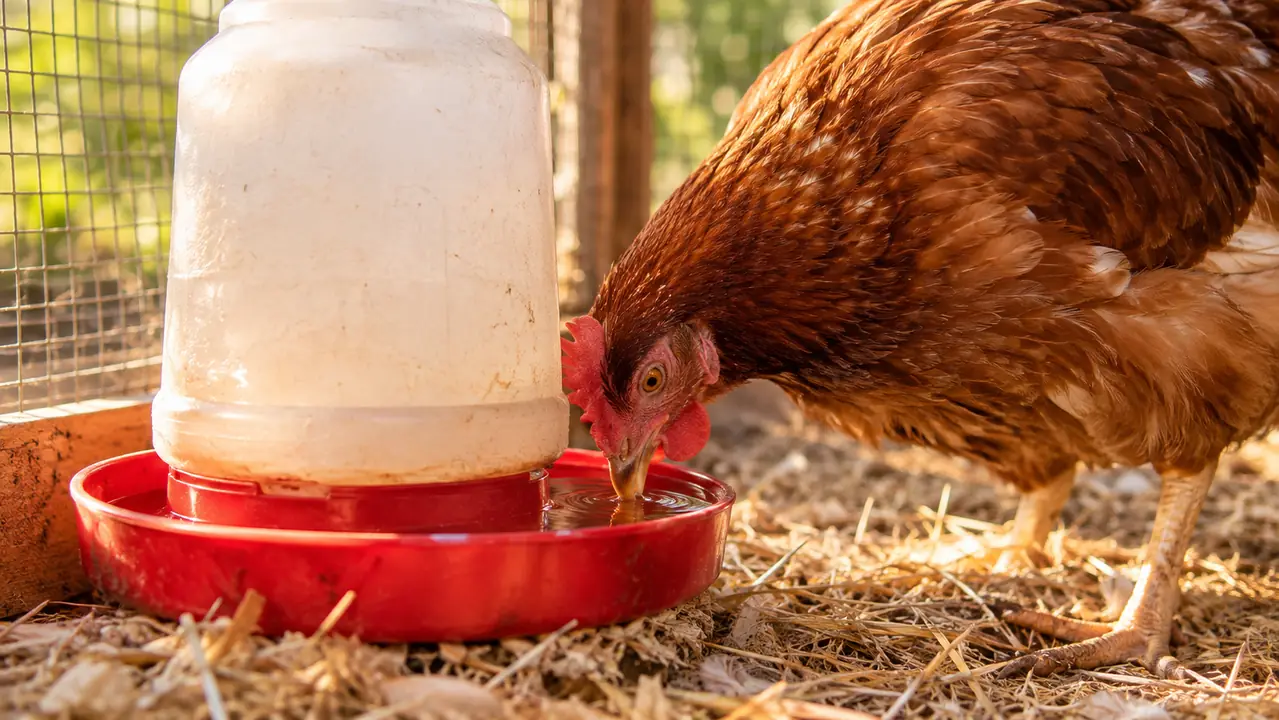
The capacity lands where it should for a flock in the teens. Fourteen hens, 6.25 gallons, a refill every four days in heat. If I had thirty birds I would be filling this every day and a half and I would want a plumbed line instead. For a dozen to twenty birds it is close to ideal, and that is not a thing I say often about farm equipment.
Clean water in front of them all day matters more than people give it credit for, especially in a hot stretch. Hens working at a warm, fouled waterer drink less, and hens that drink less lay less. I am not going to hand you a study. I will tell you that my August egg count stopped sagging the way it used to, and the only thing I changed was the water. Take that for what it is worth and no more.
The fill-from-the-top design is the feature I would pay for a second time. Every jug waterer I have owned requires flipping a full reservoir onto a base, which is a two-handed job when it is full and a spilled job when you are tired. This one you open, drop a hose in, and walk away to do something else. The BPA-free plastic on the label does not change my day to day, but I have noticed the walls have not gone chalky or brittle after two summers in the sun, which is more than I can say for the jugs.
And it has held up. Two summers in a covered run, one hard freeze, a scrub every two weeks, and the float still seats properly and the lid still fits snug. I expected to be shopping for a replacement by now. I am not, and that counts for something when you are buying plastic. The one thing I watch is the gasket area around the float, because that is where a cheap valve usually gives out first. Mine is still clean and I rinse the grit out of it when I do the biweekly scrub, which may be why.
What I Liked
- Top-fill lid means a hose refill in about a minute, with no lifting or flipping
- 6.25 gallons runs about four days for fourteen hens in summer heat
- Float valve keeps a consistent level so you are not watching it
- Unit weighs 4 pounds empty, so moving it once a season is easy
- Two summers in a covered run and the float still seats correctly
Where It Falls Short
- Not heated, and it froze solid in a January cold snap
- The float valve needs a level surface or it trickles or sits low
- Shallow trough fouls fast when a hen steps into it
- Needs a scrub and vinegar rinse every couple of weeks in warm weather
- Full, it is too heavy to carry around, so it lives in one place
That is the honest ledger. The cons are not deal breakers or I would have replaced it, but they are the reason I will not call it perfect. A four star rating from me is a good score. It means I would buy it again, and it means I would tell you the truth about it first. I have handed worse reviews to gear I still use every day, and I have handed better ones to things that broke in a year. This one sits where it sits.
Who This Is For
This is for the keeper with a dozen to twenty birds in a fixed coop and run who is tired of carrying water. You need a hose that reaches the run, a spot that is level or that you can make level with two cinder blocks, and a willingness to spend ten minutes with a brush every couple of weeks in warm weather. In exchange, the Harris Farms drinker hands you back two trips a day and a good deal of shoulder.
It suits small acreage. Fourteen hens, a walk-in coop, a covered run, one waterer that stays where you put it. That is the shape of the problem this solves and it solves it well. If you are somewhere between a hobby and a farm, this is the size of equipment that fits that gap, which is a gap most catalogs ignore entirely.
Who Should Skip It
Skip it if your winters go hard and you are not willing to add a heated base. A plastic gravity drinker in a freeze is a block of ice with a lid on it, and no float valve in the world changes that. Skip it if you run more than about twenty five birds, because you will be filling it constantly and a bigger or plumbed system is the saner answer. Skip it if your run floods or your ground shifts, because the float wants level and it will tell you so by running water onto the floor.
Skip it too if you want a waterer you never touch. This one needs a rinse, a scrub every couple of weeks, and a look at the trough most days in July. That is less work than what I was doing before, not zero work. Anybody who tells you a poultry drinker is zero work has not owned one through a Carolina August.
One more thing and then I will get out of your way. If your birds look off, if they stop drinking, or if something is wrong with a hen that you cannot explain, call your vet. Clean water in front of them is worth a great deal and it is not a diagnosis. I am not a veterinarian and I am not going to pretend to be one.
Ten minutes twice a week beats two trips a day
If your setup is a fixed coop, a hose that reaches, and a flock in the teens, that is the trade. Check the listing for the 6.25 gallon size and the top-fill lid.
Amazon Check Today's Price on Amazon →