
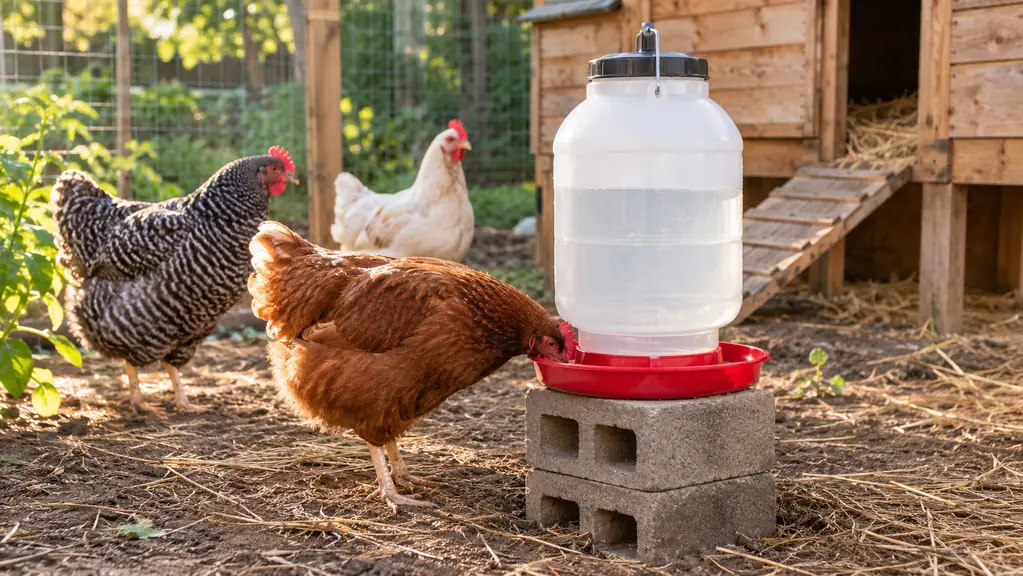
I have watered chickens both ways, and I have the dirty jugs to prove it. My 14 hens have been on the Harris Farms Easy-Fill Poultry Drinker since March 2024. Before that, through two summers, I used a cup waterer in the same covered run outside Siler City. If you are standing in a farm store trying to choose, here is the short answer: for a flock of 14 hens, the Harris Farms drinker is the better daily waterer. It holds 6.25 gallons, fills from the top, and uses a float valve to keep a consistent water level. The cup waterer still earns its place for a small pen, a sick bird, or a backup. Neither one is a set-and-forget piece of equipment, and anybody who tells you otherwise has not cleaned one in July.
The cup waterer is not junk. It is built for a different size of job. A cup style unit usually carries a smaller reservoir and lets birds drink from small cups, which keeps them from standing in open water. That matters. But on a hot week with 14 hens, I was refilling and hauling it more than I wanted, and the cups still got slimy. The Harris Farms drinker solved the volume problem and the refill problem. It did not solve the cleaning problem, and it will freeze if you leave it out in a hard snap. I will get to both.
| Harris Farms Poultry Drinker | A cup waterer | |
|---|---|---|
| Capacity | 6.25 gallons, about four days for my 14 hens in summer | Smaller reservoir, often a day or two in heat |
| Refilling | Top-fill lid, hose goes in from the top, no flipping | Lid off or reservoir removed, then fill with a jug or at the tap |
| Water level | Float valve regulates flow and keeps a consistent level | Level drops until you refill, cups can run low |
| Cleaning | Top-fill design helps, but it still needs a brush and vinegar rinse | Small parts are fussy, but the unit is easy to dump and scrub in a sink |
| Emptying and carrying | Drain it first, because a full 6.25 gallons is not a one-hand carry | Light enough to carry to the hose or sink |
| Mounting | Sits on two stacked cinder blocks in my run | Often hangs on wire or a wall, off the floor |
| Winter handling | Froze solid in January 2025, so I use a heated base in cold snaps | Small volume freezes fast, but it is easier to swap out or bring inside |
| Best flock size | Small to medium flock, my 14 hens fit well | Small pens, chicks, or a few birds |
| Best daily job | Daily watering for a laying flock | Backup, sick pen, or tiny setup |
Where Harris Farms Wins
Volume is the first win, and it is not a small one. The Harris Farms drinker holds 6.25 gallons. With 14 hens in July, I fill it from the top with a hose about every four days. In cooler months I get closer to a week. My old cup waterer did not give me that kind of margin. I was checking it every morning and often topping it off. If you work away from home or you have a garden, goats, and a job pulling at you, that difference is the whole argument. The birds run out of water less often, and I make fewer trips with a jug.
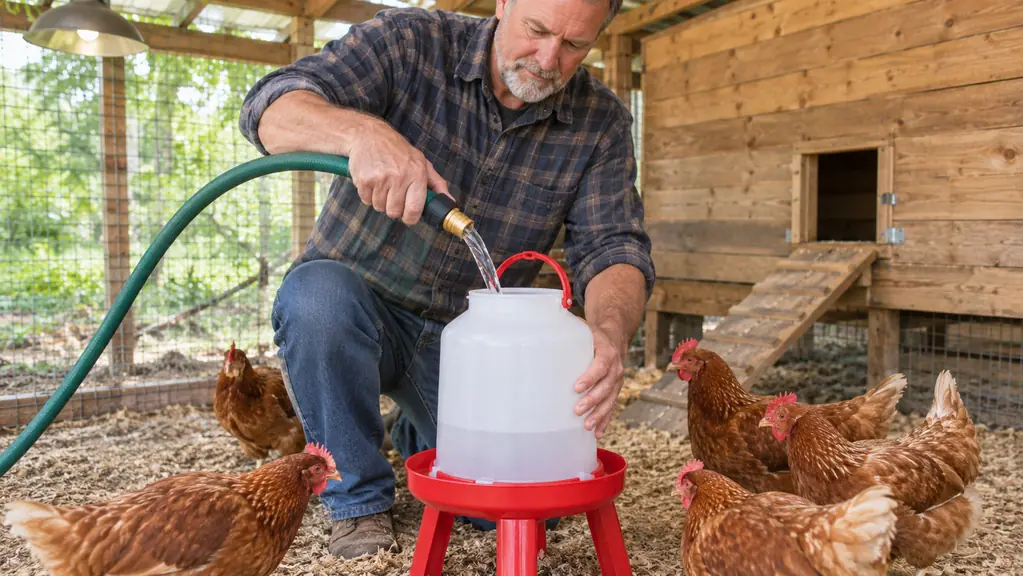
Refilling is the second win. The top-fill lid is the feature I use every time, and it is the reason I stopped dreading the job. I do not flip a full waterer over. I do not wrestle a reservoir off a base. I set the hose in the top, fill it, and put the lid back. The float valve regulates the flow and keeps a consistent water level, so the hens are not waiting on me to notice a dry cup. The cup waterer was not hard to fill, but it was more steps, and more steps in August means I put it off. Putting it off is how birds get thirsty.
Placement favors the Harris Farms unit for a walk-in run. Mine sits on two stacked cinder blocks so litter stays out of the water. It is heavy enough when full that I do not move it around, which is fine because I do not need to. It stays put, the hens come to it, and the water is there. The cup waterer I used hung on the wire. That kept it off the floor, but it also meant the cups were at beak height and easy to bump. Both setups work. The Harris Farms one fits my run better because I have the space for a stationary waterer and I want the volume.
Where A Cup Waterer Wins
I am not going to pretend the cup waterer has no advantages. The first is handling. A cup waterer is small. When I needed to dump it, scrub it, or bring it in during a freeze, I could carry it with one hand. The Harris Farms drinker holds 6.25 gallons, so when it is full I drain it before I move it. That is not a defect for a stationary setup, but it is a real difference if you move your waterer between pens or you are not comfortable lifting a full unit. For a small coop or a tractor, the cup waterer is less of a commitment.
Mounting is the second win. Cup waterers are often designed to hang on wire or a wall, which keeps them off the floor and out of the litter. My Harris Farms drinker sits on cinder blocks because that is what works in my covered run, and I had to set those blocks. If your coop has limited floor space, a hanging cup waterer can be the cleaner answer. It also gives you a way to water a sick bird or a small group without setting up the big drinker. I keep a cup waterer in the shed for that reason. It is not my daily waterer, but it is a useful backup.
Winter handling is the third win, with a caveat. My Harris Farms drinker froze solid in January 2025 during a cold snap. I now keep a heated base under it in winter. That base is an extra piece of equipment and an extra thing to plug in. A small cup waterer freezes faster, but it is easier to carry inside, thaw, and refill. If you have three hens and a garage, that trade might suit you better. If you have 14 hens, carrying a small unit in and out twice a day gets old too. Neither one wins winter outright. You are choosing which job you want.
The Waterer That Cut My Summer Refills to Twice a Week
The Harris Farms Easy-Fill Poultry Drinker holds 6.25 gallons, fills from the top, and uses a float valve to keep a steady water level. For my 14 hens, that is about four days between refills in summer. If you are still topping off a small cup waterer every morning, this is the upgrade that changes the chore.
Amazon Check Today's Price on Amazon →How I Set It Up in the Run
My setup is simple because I am not handy and I do not want a project. I stacked two cinder blocks in the covered run, set the Harris Farms drinker on top, and ran a hose to the top-fill lid. The blocks raise it enough that litter and scratch grains do not get kicked into the water. The hens step up to drink without a ramp. I checked it for wobble the first week, then left it alone. That is the whole installation. No plumbing, no mounting bracket, no drilling into the coop.
I fill it about every four days in summer and about once a week when the weather cools. I do not wait for the float valve to stop working. I check the water level when I gather eggs, and if it is low I top it off. The float valve regulates the flow, but it is not a reminder service. That is the mistake I made with the cup waterer too. I thought a bigger waterer meant I could stop looking. It does not. It means I look less often, not never.
Every couple of weeks I scrub it with a brush and a vinegar rinse. The top-fill lid makes that easier because I can reach in from the top instead of flipping the unit. I dump the old water, scrub the inside, rinse, and refill. In July I do it more often because the heat makes everything grow faster. If I see algae or the water smells off, I clean it that day. I do not use a harsh cleaner and then put it straight back. I rinse until the water runs clean, which is the same rule I used when I worked in a school cafeteria. Clean water is not a complicated idea, but it does take a routine.
What Daily Use Taught Me
The first thing I learned is that volume does not fix neglect. I still have to check the waterer. The second is that a top-fill lid matters more than I expected. I have a bad shoulder from years of lifting trays, and flipping a full waterer was the part I hated. The Harris Farms drinker removed that motion. The third is that the cup waterer was not the problem. My old routine was the problem. I was using a small tool for a flock that had outgrown it.
By the end of the first summer, the difference showed up in my routine, not in a chart. I was making fewer trips with the hose. I was not sending Ron out to check water before we left for town. I was not finding a dry cup at 7 p.m. and feeling like I had let the hens down. That is the kind of result you cannot put on a label. The hens did not suddenly lay more eggs because of a waterer. They laid the way healthy hens lay when they have water in front of them. The change was on my end.
I also learned where the Harris Farms drinker is not convenient. It is not the thing I grab for a sick hen in a dog crate. It is not the thing I carry to the far side of the paddock for the goats. It stays in the run, and it does that one job well. The cup waterer is the one I keep in the shed for odd jobs. Having both is not a failure. It is how a small farm works. You use the right size tool for the job, and you stop trying to make one tool do everything.
The Harris Farms drinker did not make me a better chicken keeper. It made the water job small enough that I actually do it on time.
The Cleaning and Winter Details Nobody Mentions
Cleaning is the part I would ask about if we were talking in the feed store. A 6.25 gallon waterer is not self-cleaning, and the float valve is not something you ignore forever. I scrub the inside with a brush and a vinegar rinse every couple of weeks. I pay attention to the corners and the valve area. I do not take the valve apart unless the water level stops holding, because I am more likely to lose a small part than fix it. If the flow gets sluggish, I dump, rinse, and refill first. If that does not solve it, I look closer. That is as technical as I get. For anything wrong with the birds themselves, I call the vet.
Winter is the other detail. In January 2025 the waterer froze solid. I did not expect it to happen overnight, but it did. Now I keep a heated base under it during cold snaps. The base is not part of the Harris Farms drinker. It is a separate tool I use because I have 14 hens and I am not carrying water twice a day in January. If you live where it does not freeze hard, you may never need one. If you do, plan for it before the first cold night, not after. A frozen waterer is not a crisis if you have a plan. It is a miserable morning if you do not.
Who Should Buy Which
Buy the Harris Farms Easy-Fill Poultry Drinker if you have a small to medium flock and a permanent run. My 14 hens are a good fit. You want fewer refills, you have a spot for a stationary waterer, and you are willing to check and clean it on a routine. The 6.25 gallon capacity is the reason to choose it. The top-fill lid is the reason you will keep using it. It is also the better choice if you have a bad shoulder or you are tired of flipping a full waterer. That was my reason, and it has held up.
Buy a cup waterer if you have a tiny flock, a chicken tractor, or a pen you move. It is easier to carry, easier to hang, and easier to swap out in a freeze. It is also a good backup for a sick bird or a new group. I would not choose it as the only waterer for 14 hens in a North Carolina summer. I did that for two years, and I was the one who paid for it in trips and worry. If you have three hens and a shaded coop, it may be all you need.
Buy both if you are like me. The Harris Farms drinker stays in the run. The cup waterer stays in the shed for odd jobs and winter swaps. That is not a sales pitch for more equipment. It is what happened after I stopped trying to make one waterer cover every situation. The daily job goes to the big drinker. The odd jobs go to the small one.
Stop Hauling Water Twice a Day for a Flock That Outgrew the Small Waterer
The Harris Farms Easy-Fill Poultry Drinker holds 6.25 gallons and fills from the top, with a float valve that keeps a steady level. If your current waterer runs dry before you get back to it, this is the one I would start with.
Amazon Check Today's Price on Amazon →