
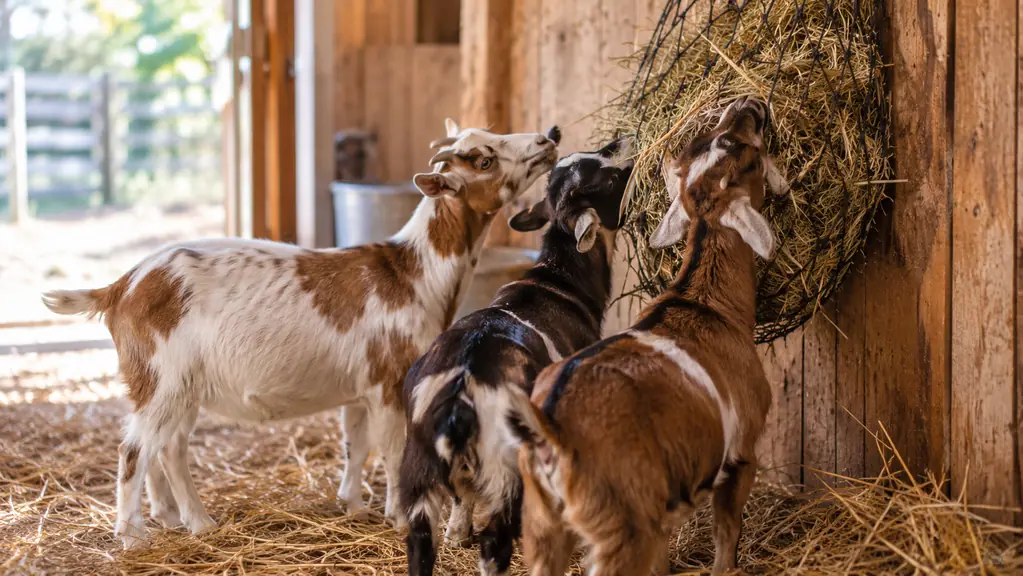
For two winters I fed my three Nigerian Dwarf does out of an open wall rack. I would fork two flakes into it before breakfast, and by the time I came back with the water bucket, Hazel had pulled a mouthful out, dropped it, and stepped on it. Pepper did the same thing. Clover, who is three and at the bottom of the pecking order, learned to grab what she could and back off. By evening a good third of that hay was on the shed floor, mixed with straw and manure. I was not feeding goats so much as buying bedding. I have kept goats since 2021, and I had already tried feeding on the ground and feeding less at a time. Neither fixed the mess.
I tried a bigger rack. I tried feeding smaller amounts more often. Both helped a little and neither fixed the reason: an open rack lets a goat take more than she can hold in her mouth, and the extra falls. In November 2024 I hung a Tough 1 Slow Feed Hay Net on the wall of the goat shed instead. Wasted hay dropped by roughly half. Not to zero. Half. I still sweep the floor, but I am not throwing away a flake a day anymore.
Stop Buying Hay Your Goats Will Sleep On
The Tough 1 Slow Feed Hay Net holds a large amount of hay behind 2 inch knotted openings, so the does take smaller bites instead of pulling a mouthful onto the floor. I fill mine once a day in winter and the shed floor stays a good deal cleaner.
Amazon Check Today's Price on Amazon →Step 1: Figure Out How Much Hay You Are Actually Losing
Before you hang anything, get a number. Pick a normal feeding day, not a storm day and not a day when you are already late. Fill your rack or feeder the way you always do. At the next feeding, take a fork and a bucket and pick up everything on the floor around the feeder. Put it in the bucket and look at it. That is your waste, or at least the part you can see. Do it on a dry day so you are not weighing wet hay and fooling yourself.
Separate the clean hay from the soiled hay as you pick it up. Some of it was pulled out, inspected and dropped. Some of it was walked on, peed on and mixed with manure. The first pile is waste you can fix with a slower feeder. The second pile is what feeding on an open floor does, and a net helps with that too because the hay stays up off the bedding. My clean pile was smaller than I expected. The soiled pile was bigger.
My number was ugly. Two flakes in the morning, and by evening about a third of it was on the floor. If you are putting out four flakes a day and losing a third, that is more than a flake a day going into the bedding. Over a winter that adds up to real hay. You do not need a fancy scale. You need to see the pile once and admit what it is. I wrote my number on the shed wall with a pencil so I would stop pretending it was smaller than it was.
Step 2: Hang It at Head Height, Then Tie the Bottom Up
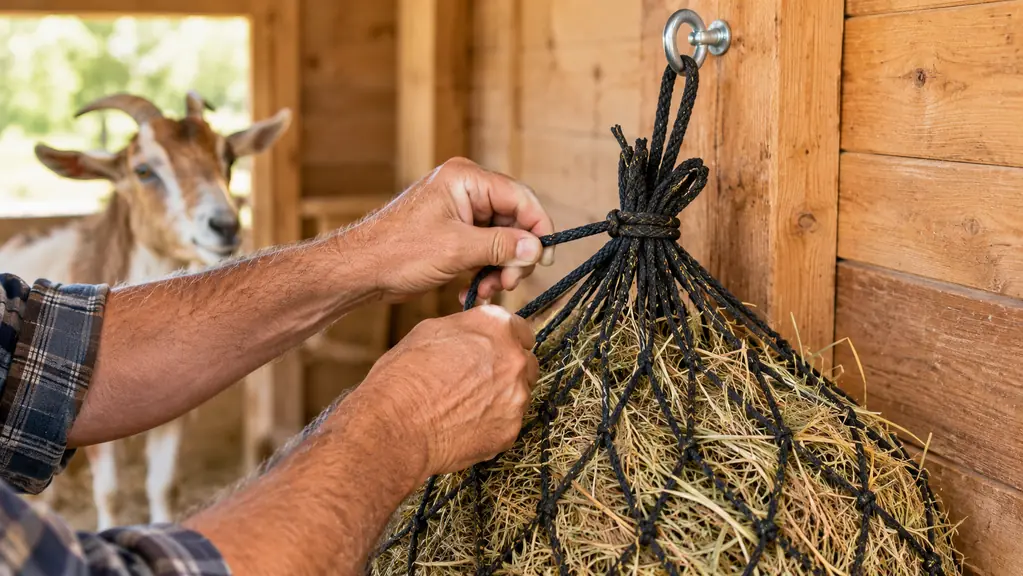
Find a wall stud in the shed, not just a board, and put a sturdy eye bolt in it at about the height of the goats' heads. Not above their reach and not down at chest level. A goat should be able to stand square and eat without stretching her neck up or dropping her head to her knees. On my shed the bolt sits so the bottom of the net hangs just above the bedding. I used a bolt long enough to bite into the stud, not a little screw that pulls out the first time a doe leans on it.
Then gather the bottom of the net and tie it off. This is the part people skip. A hay net hanging loose with a long bottom is a place for a back leg to go through, and a goat that panics with a leg in a net can hurt herself badly. I pull the bottom up and tie it so the lowest part is well above the floor and snug against the wall. My does are disbudded, so horns are not the issue here, but legs are. Check it every time you fill it. I use a simple knot I can undo with cold hands.
The Tough 1 net is a polyester net with 2 inch knotted openings. The listing gives the size as 12 by 4 by 3 inches and 9.14 ounces, which is the net itself, not a bale of hay. It is sold for horses, and my Nigerian Dwarfs are a lot smaller than a horse, but the net does not care. It holds a large amount of hay and the openings are small enough that the does have to work at it. That is the whole point. It is manual, with no moving parts and nothing to adjust.
Step 3: Fill It Loose, Not Stuffed
Do not cram hay into the net like you are packing a feed sack. Break the flake apart, shake it out, and put it in a handful at a time. You want the hay loose enough that the net hangs full without being tight as a drum. A stuffed net is hard for the goats to work and hard on the seams. It also defeats the purpose, because the hay at the center gets packed and the goats fight the outside of it. If you can thump it and it sounds solid, it is too tight.
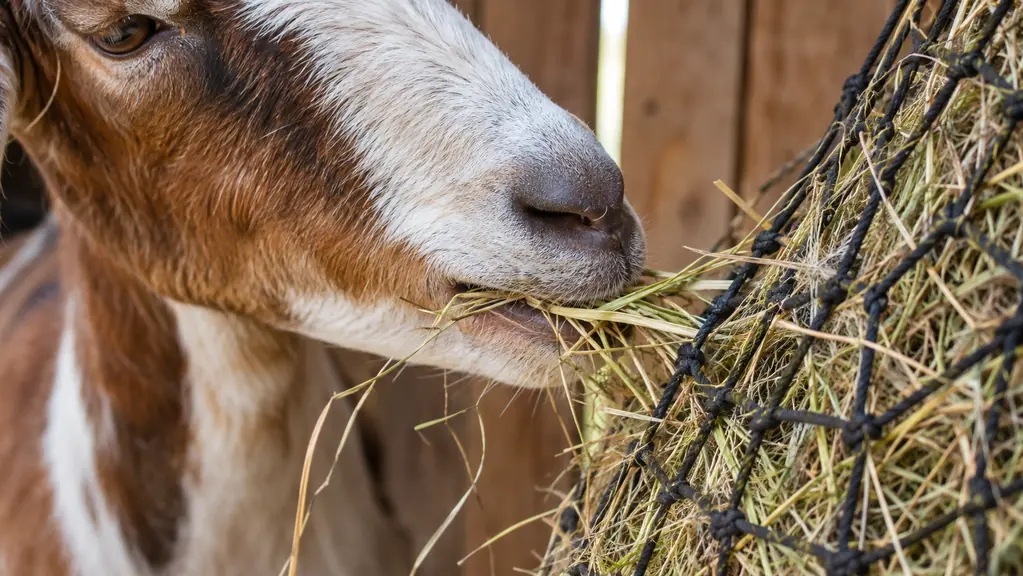
With the 2 inch knotted openings, the does cannot get a whole mouthful at once. They nibble. Hazel, who is six and the boss, will still try to grab and pull. The difference is that she cannot pull a softball-sized clump out and let it fall. She gets a few strands at a time, and most of what she gets goes in her mouth. Pepper and Clover get their turn at the net instead of eating off the floor. The knotted openings are the mechanism. Everything else is just how you hang it.
In winter I fill the net once a day, in the morning, and that is usually it. In spring and summer, when the browse paddock has good growth, I fill it less or skip a day. The net is not a reason to feed more hay than the goats need. It is a way to make the hay you do feed last longer. If they clean it up and stand around looking bored, that is normal. Goats are supposed to be a little hungry between feedings. Do not leave wet hay in the net for days, because it will mold and then you have a different problem.
Step 4: Give Them a Few Days to Learn It
The first morning, my does acted like I had hung a snake on the wall. Hazel pawed at it. Pepper bit the net itself. Clover stood back and watched. That is normal. Do not take it down and put the rack back up the first time a goat complains. Give them a few days. By the third morning they were working the net like they had always done it. I talked to them while they figured it out. Maybe that helped them. It definitely helped me.
Watch the whole group, not just the boss doe. A slow feeder can turn into a guard station if one goat parks herself in front of it. I have one net, and my three does are close enough in size that they share it, but I still stand out there at feeding for the first week. If Clover was getting pushed off every time, I would hang a second net on another wall, not take the first one down. One net per goat is overkill for three does. One net and a second spot if somebody gets bossy is about right.
Check the height after a week. A net stretches a little as it fills and as the goats pull on it. If the bottom is getting close to the floor, tie it up shorter. If the eye bolt is pulling out of the wall, stop and fix it before you fill the net again. I would rather spend ten minutes with a wrench than find a doe tangled in the morning. After the first week, the routine settles down and you can stop standing there with your coffee.
Step 5: Inspect It Weekly and Retire It When It Wears
Polyester is strong, but it is not indestructible. Once a week I run my hands over the net and look at the knots, especially around the bottom where it is tied and around the top where it hangs. A broken knot or a pulled strand is easy to miss when the net is full. I check it empty, before I fill it, in good light. I also look at where the net rubs the wall, because that is where a hole starts.
Small holes are not a disaster, because the openings are already 2 inches. A tear that gets wider than the openings is a different story. Once a goat can put her muzzle through a big hole and pull a full mouthful, the net is not slowing her down anymore. That is when I retire it. The listing carries a 90 day guarantee, and I read that sort of thing before I toss a net in the trash, but a net that has been used hard for a winter may simply be done. That is not a failure of the net. It is hay and hooves doing what they do.
Adjust with the season. In deep winter, when the does are on hay full time, the net is full every morning. In April, when the paddock comes in, I might fill it every other day. In the cold, check that the hay is not frozen into a block before you put it in. Break it up. A frozen chunk in a net is a goat standing there chewing on ice, and that is not the point of any of this. The net is a tool for feeding. It is not a substitute for paying attention.
What Else Helps
Keep the area under the net clean. I put an old rubber mat under mine, not because the net needs it but because it makes sweeping easier. Hay that falls on a mat can be swept up and fed to the chickens if it is still clean, or thrown in the compost. Hay that falls on wet bedding is gone. The mat also keeps the bottom of the net out of the muck when it swings. The hens will scratch through the clean leavings, which is a nice bonus.
Do not overfill. It is tempting to stuff the net so you can skip a day, but a packed net is harder for the goats to use and more likely to tear. The net holds a large amount of hay, but it still has a limit. I would rather fill it once a day and know the hay is moving than fill it twice as full and let it sit there getting stale. Hay that sits and gets damp is not saving you anything.
Give them water and minerals nearby. A goat working at a slow feeder will drink more than you expect. My does have water in the shed and a mineral feeder on the wall. If the water is across the paddock and the net is here, they will stand at the net and not drink enough. That is not a hay problem, but it shows up as one when they go off feed. Keep the water clean and close and you will have fewer mysteries.
And call the vet for anything that looks like illness or injury. I am not a veterinarian. I have trimmed my own does' hooves every six to eight weeks for years, and I still call the vet when something is off. A goat that stops eating, has a swollen jaw, or is drooling is not a hay net problem. That is a vet call. The net is a tool for feeding, not a cure for anything.
Wasted hay dropped by roughly half. Not to zero. Half. I still sweep the floor, but I am not buying a flake a day to build bedding.
Hang It Once and Stop Raking Hay Every Morning
The Tough 1 Slow Feed Hay Net is the simplest fix I have found for goats that pull hay out and walk on it. Fill it loose, tie the bottom, and check it weekly. That is the whole system.
Amazon Check Today's Price on Amazon →