
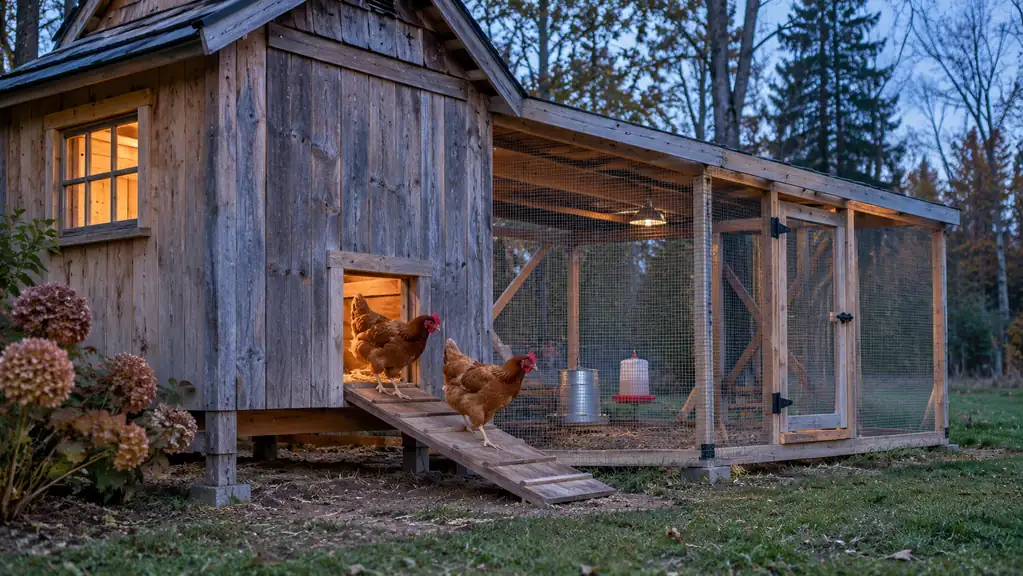
The evening I finally ordered the NyPots automatic coop door, I had 14 hens instead of 16, and I was mad about it. A fox had come through the pop door sometime between four in the afternoon and dark, on a night Ron and I were both off the property longer than we planned. Two Buff Orpingtons gone. No mess, no noise, nothing to find but feathers by the gate.
That is the honest origin of this review. I did not buy the NyPots door because I wanted gadgetry in my barn. I bought it because a plain slide latch and my own memory had already cost me two hens, and I was tired of planning my afternoons around whether I could get home before sunset. Sixteen months later I have opinions, and not all of them are flattering. If you are shopping for one of these and want the version where everything is wonderful, this is not that piece. If you want to know what the thing actually does on a real coop, with real weather and real hens, keep reading.
I want to set the table before I get into it. My coop is a walk-in wooden building with a covered run attached, and the pop door is a standard cutout with a short wooden ramp under it. I have kept hens since the spring of 2019, so I am not new at this and I am not easily impressed by a box with a motor in it. The NyPots unit has been on that pop door since September 2024. Everything below comes from that one coop, one flock, and sixteen months of Piedmont weather, which means a lot of wet and not much snow. Your mileage in Minnesota will differ and I am not going to pretend otherwise.
The Quick Verdict
Reliable where it matters most, the evening close. The morning open is slower and fussier than the listing suggests, and I still do a head count at dusk.
Amazon Check Today's Price →The door that ends the sunset sprint. See today's price on Amazon.
NyPots runs on the included solar panel and handles the dusk close on its own, which is the job that actually protects your flock.
Amazon Check Today's Price on Amazon →How I've Actually Used It
Mine went on the pop door of a walk-in wooden coop with a covered run in September 2024. The unit itself is small, 9.6 by 1.6 by 13 inches and about a pound and a half, and the opening it gives you when the door is up is 8.2 inches wide by 9.6 inches high. That opening matters more than the marketing copy does. My hens are full grown Buff Orpingtons and Barred Rocks, and a couple of the Orpingtons are wide through the hips. They go through it fine, but it is not a big doorway. If you have heavy breeds and a crowd of them pushing at the ramp at dusk, expect a short traffic jam and a little complaining.
The kit is a door, a solar panel, a charging cable, a screwdriver and eight screws. That is genuinely all that comes in the box. There is no mounting bracket beyond the panel itself, no extension cable for the panel, and no hardware for a door frame thicker than mine is. I mounted the unit beside the pop door and ran the panel up to the coop roof where it gets sun most of the day, and I used a couple of screws out of my own coffee can because the eight in the box were accounted for elsewhere. If you are the kind of person who opens a box and expects to finish the job with what is in it, budget for a hardware store run.
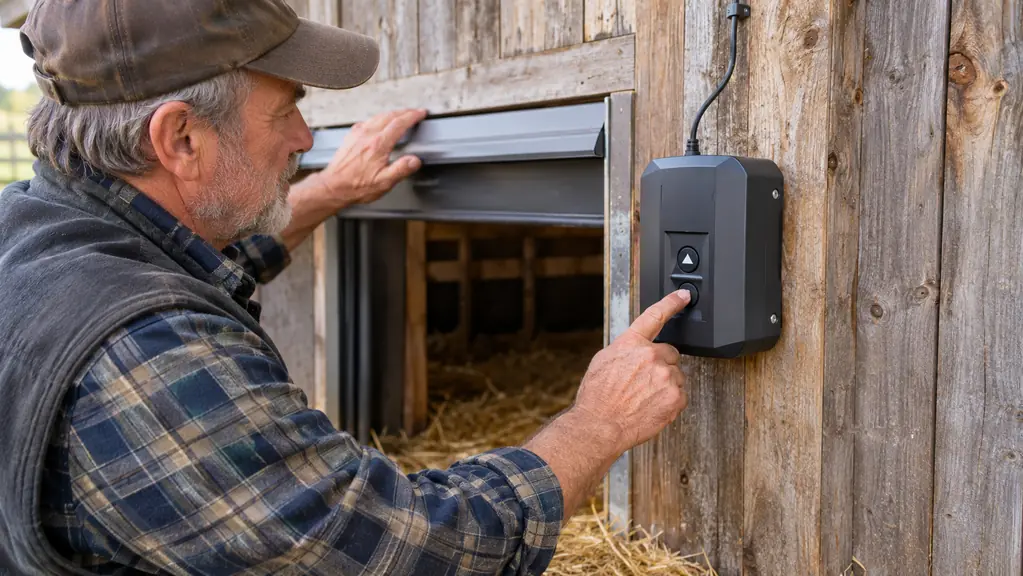
NyPots gives you a timer and a light sensor, and those two modes are the whole brains of the thing. There is no app, no remote, no Wi-Fi, no account to create. You walk out to the coop and press buttons on the unit. In practice that means the setup you do at the coop is the setup you live with, which I have decided is a feature rather than a failing. I cannot accidentally change it from the kitchen table, and I cannot lose a password to it, and there is no firmware update to interrupt a Tuesday.
The panel has kept the unit charged from the day I put it up. I have never run the charging cable out to it, not once, not even through the grey stretch we get in late winter when it feels like the sun has gone to Florida without us. That is the part of this purchase I was most skeptical about and the part that has quietly just worked.
The Light Sensor Mode Is Better Than I Expected and Worse Than I Hoped
For most of the year I run it on the light sensor, which opens around dawn and closes around dusk on its own. The close is excellent. That is the part that matters and it has not missed a dusk yet in sixteen months, including a run of nasty overcast evenings in March that I was sure would confuse it. I have not lost a hen to a predator since it went in. Not one. Whatever else I say here, that is the reason the door stayed on my coop.
The open is where the light sensor gets fussy. On clear mornings in spring and summer it opens early and the hens are out before I have my boots on, which is lovely. On a grey, low-ceiling December morning, the sensor reads dark and the door sits shut while 14 hens pile up against it and complain. They are not in danger, they are just annoyed, and so am I, because I am standing in the cold at six thirty waiting on a photo sensor to make up its mind about the weather.
One winter I got tired of it and switched over to timer mode for about three weeks. The unit does have a timer, and it lets you set an open time and a close time in a paired schedule, where you set open at 07:00 and close at 07:00 and the thing runs that schedule day after day. It worked. It also taught me something I did not want to learn, which is that my schedule is not the sun's schedule. For those three weeks the coop opened at a fixed hour whether it was light out or not, and closed at a fixed hour whether the hens had gone in or not. In January that meant a dark walkout for them and a dark walk-in for me. I went back to the light sensor and I have stayed there.
I have not lost a hen to a predator since it went in. Not one. That is the reason the door stayed on my coop.
Solar panel included, timer and light sensor built in, no wiring to run.
The panel mounts on the coop roof and charges the unit. Mine has never gone dead in sixteen months of Piedmont weather.
Amazon Check Today's Price on Amazon →The manual mode is there too, and I use it more than I expected, mostly when I am doing something in the coop and want the door to stay put. It bypasses the automatic schedule. That is the mode I reach for when I am moving a hen or cleaning out the deep litter and do not want the door cycling behind me while I have my back turned.
What Nobody Tells You Before You Buy
First, this is a small unit for small animals. The listing says poultry under 10 pounds, and it means it. My hens are under that, but a couple of the Orpingtons are close enough that I would not want to go any heavier. The dog size field on the listing says small, and that is a fair hint about the scale of the whole assembly. If you are picturing something that swings a big barn door, this is not it. It is a compact panel that covers a compact opening, and it does that one job.
Second, you are going to have to be honest with yourself about your coop. The unit is 1.6 inches deep at the body, and if your pop door frame is thick, weathered, warped, or hung at an angle, you are going to be shimming and fiddling to get it to sit clean. Mine was decent and it still took me the better part of an afternoon with a level and a second trip out for screws. Somebody with a plywood coop and a square frame will do it in twenty minutes flat. Somebody with a hundred-year-old tobacco barn conversion, like my neighbor's place up the road, is going to have a project on their hands and should plan for it.
Third, there is no battery readout and no warning when the panel is shaded. In practice the solar panel has kept up fine on my roof, but there is no little screen telling you the charge is low and no beep telling you something is wrong. You find out by walking out and finding the door sitting exactly where it was the night before. That happened to me once, in a stretch where a mimosa limb grew out over the roof and shaded the panel more than I had noticed. The door did not fail, it just did not move. I cut the limb. The lesson is not that the panel is weak, it is that you have to actually look at where you put it and keep the branches off it.
Fourth, and this is the one that bothers me, the door does not know whether a hen is in the doorway. It is not a sensor that detects an animal. It is a door on a schedule, driven by light or by clock. If a hen is dawdling on the ramp at close time, the door closes on schedule regardless of her opinion. In sixteen months I have not had a hen caught, because mine go in before dusk like they are paid to, but I have stood at the pop door watching a slow Barred Rock take her sweet time and felt my stomach tighten.
Fifth, rain. This is not a complaint, just a fact of the design. The unit is mounted outside, on the coop, in the weather, and it is going to get wet. Mine has sat through sideways thunderstorms and a hailstorm that took shingles off the shed, and it has kept running. But the buttons get gritty and the little panel gets a film on it, and about twice a year I go out with a rag and wipe it down so I can read what I am pressing. Nobody tells you that part. It takes two minutes and it is worth doing before you need to change a setting in the dark.
The Head Count Habit
I still walk out at dusk and count. Every night, in the cold, with a flashlight in November. The NyPots door did not replace that habit and I do not think it should. Fourteen heads, or I go looking. Twice this year the count came up short and both times it was a hen that had decided to roost on top of the run instead of inside, which is her problem and not a door problem. But if I had trusted the door and gone to bed, I would not have known until morning, and morning is too late for a hen on a roost bar in the open.
What the door did replace is the frantic version of that walk. It used to be that a late evening out meant driving home in the dark with my jaw set, knowing the pop door was wide open and the field was full of things with teeth. Now the close is handled before I get there and the walk is a check, not a rescue. I cannot overstate how much I enjoy that difference. It is the whole reason I keep the thing, and it is why I have talked two neighbors into buying one.
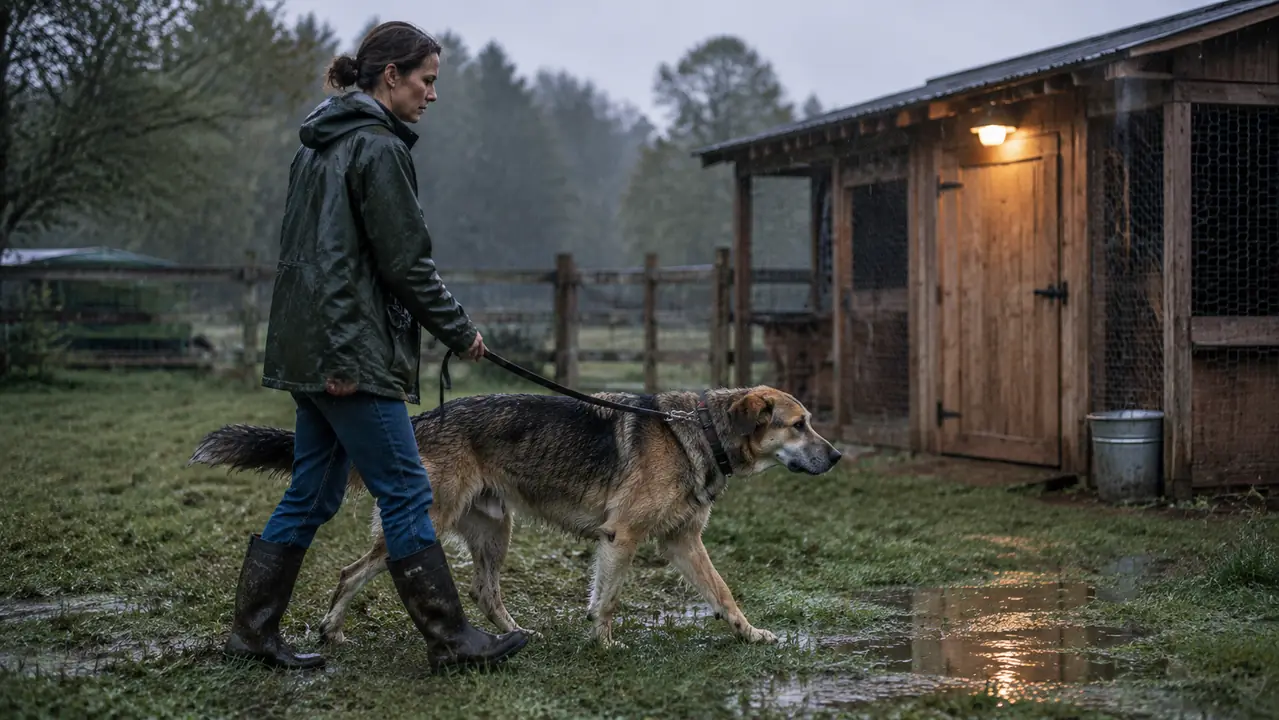
I also still latch the run gate and I still check the fence line. A coop door is one layer. It is a good layer and it is the layer that was failing me, but it is not a fence and it is not a guard dog. Biscuit, my old farm dog, is a fine alarm and a poor deterrent, and he stays out of the coop anyway because he has opinions about hens.
Pros and Cons After Sixteen Months
What I Liked
- The dusk close has been completely reliable, including on bad weather evenings
- The included solar panel has kept up without any manual charging in sixteen months
- No wiring, no app, no Wi-Fi, nothing to break and nothing to update
- Timer mode is a real fallback for cloudy winter mornings
- Manual mode is easy to reach when you are working inside the coop
- Compact footprint, and the 8.2 by 9.6 inch opening suits standard laying hens
- Install hardware is minimal, so it comes off the wall easily if you move coops
Where It Falls Short
- Light sensor opens late on dark winter mornings
- No low battery warning and no panel-shade indicator of any kind
- Door will close on the schedule whether a hen is in the way or not
- No animal sensor, no obstruction detection, nothing smart about it
- Install takes real time if your pop door frame is old or out of square
- The opening size is not generous for heavy breeds
- Eight screws and a screwdriver is a thin hardware kit for the job
- Buttons and panel need an occasional wipe down after a muddy season
What I'd Have Done Differently
Two things. I would have mounted the solar panel higher and further from the treeline the first time instead of the second time, because I lost a couple of weeks to a shaded panel and a limb I should have seen from the ground. And I would have measured my pop door frame before the box arrived rather than after, because that afternoon of shimming would have been an hour if I had known how out of square that opening really was.
What I would not change is buying it at all. I want to be clear about the tradeoff here. The NyPots door is not a smart device and it does not pretend to be. It is a small motorized door with a light sensor and a clock, mounted on a small opening, powered by a small panel. Judged as that, it has done its job every single evening for sixteen months, and the two hens I lost before it went in were worth more to me than the door ever cost.
If I were starting over with what I know now, I would buy it again and I would install it in October instead of waiting for a fox to make the decision for me. That is the short version. The long version is everything above.
Who This Is For
You should buy this if you keep a small laying flock in a walk-in or raised coop with a standard pop door, you are out of the house at dusk more than a couple of times a week, and the thing that keeps you up is the evening close. That is the job this unit does best and most reliably. It also suits anyone whose coop sits far enough from the house that walking out in the dark is a genuine chore, or anyone on a fixed work schedule who wants the flock locked up whether they are home or not.
It is a decent fit if you are like me and you do not want another thing on the Wi-Fi. There is nothing to configure, nothing to update, nothing to lose the password for. You press buttons at the coop and that is the end of it.
It also makes sense if you travel for a night or two and have a neighbor willing to look in. The door keeps the schedule without them, so all they have to do is count heads and top off the feeder, which is a much easier favor to ask than please come lock my chickens up at dark.
Who Should Skip It
Skip it if your real problem is the morning open. If you are up before dawn anyway and what you want is a door that reliably greets the sunrise, the light sensor on this unit will frustrate you for a couple of months a year, and you will be out there working the manual mode or the timer instead. Skip it if you have a very old, out of square, or heavy timber door frame, because the install will fight you and you will need hardware that is not in the box.
And skip it if you want a door that senses an animal and refuses to close on a hen. That is not what this is, and no amount of hoping will make it one. If that specific worry is what has kept you on a manual latch, stay on the manual latch until you find a unit that actually detects obstruction, or buy the NyPots and keep doing the head count like I do. I would rather you go in clear eyed than disappointed.
One more thing, and I mean this. A coop door is a piece of equipment, not a substitute for looking at your birds. If you have a hen that is lethargic, off her feed, or standing hunched with her feathers puffed, a door is not going to fix that and neither am I. Call your vet. I trim goat hooves and I fill waterers and I know what I know, and what I know stops well short of doctoring.
Sixteen months, no hens lost at dusk. That is the whole case for it.
If the evening close is your problem, the NyPots door solves it. If the morning open is your problem, read the section above again first.
Amazon Check Today's Price on Amazon →